🔬
What is it?
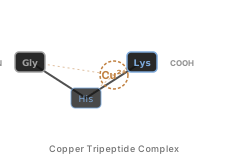
GHK-Cu is a naturally occurring tripeptide — three amino acids in the sequence glycine-histidine-lysine — bound to a copper(II) ion. Your body produces GHK-Cu endogenously through the proteolytic breakdown of larger proteins, and it circulates in plasma, urine, and saliva at concentrations that vary significantly with age: young adults typically maintain plasma levels around 200 ng/mL, while adults over 60 show levels below 80 ng/mL. That age-dependent decline is what sparked decades of research interest — GHK-Cu behaves like a biological signal that diminishes with time.
What separates GHK-Cu from almost every other research peptide is its scope. Most peptides do one specific thing in one tissue type. GHK-Cu has been documented in peer-reviewed literature to influence collagen and elastin synthesis, matrix metalloproteinase (MMP) regulation, antioxidant enzyme production, nerve tissue repair, lung tissue biology, and hair follicle cycling — an extraordinary range for a molecule with only three amino acids. Comprehensive genomic analysis published by Pickart and Margolina documented GHK-Cu influencing the expression of over 4,000 genes, approximately 31% of all human protein-coding genes, including broad clusters involved in inflammation, DNA repair, mitochondrial function, and extracellular matrix organization.
The copper component is not cosmetic. Copper(II) is an essential trace mineral that serves as a cofactor in over 30 human enzymes. By delivering copper in a bioavailable, chelated form, GHK-Cu may make copper accessible to cells in a way that free ionic copper (which can be cytotoxic via Fenton-like reactions) cannot safely achieve. The imidazole group of histidine in the middle position of the peptide is particularly critical for copper coordination — it forms the anchor of the chelate ring structure.
Despite its small size (three residues vs. 15 for BPC-157, or hundreds for larger proteins), GHK-Cu penetrates tissues with relatively high bioavailability. Research has documented transdermal penetration in skin models, making it one of the few peptides where topical delivery has been studied alongside systemic routes in laboratory contexts.
📡 Weekly peptide research updates — regulatory updates, new compound profiles, COA alerts.
⚠️ FDA PCAC: -- days left
No spam. Unsubscribe anytime. 7 peptides under review — see what's at stake →
⚙️
Mechanism of Action
GHK-Cu operates through several overlapping mechanisms rather than a single receptor-ligand interaction. This multi-pathway activity is both what makes it scientifically interesting and what has made it difficult to attribute any single effect to any single mechanism.
Copper Delivery & Metalloenzyme Activation
GHK-Cu acts as a high-affinity copper transporter (binding constant ~10¹⁷ M⁻¹ for Cu²⁺). Once internalized by cells, it can donate copper to metalloenzymes that require it as a catalytic cofactor. Two of particular research interest:
- Lysyl oxidase (LOX) — a copper-dependent enzyme that catalyzes the cross-linking of collagen and elastin fibers. Without functional LOX activity, newly synthesized collagen cannot form stable, tensile-strength fibers. GHK-Cu's copper delivery may therefore support the entire downstream chain of structural protein assembly.
- Superoxide dismutase (Cu/Zn-SOD) — the primary intracellular antioxidant enzyme. By supplying copper, GHK-Cu may enhance SOD activity, reducing oxidative damage — a proposed mechanism in wound healing and aging research contexts.
Gene Expression Modulation
GHK-Cu's most remarkable documented effect is its influence on gene transcription. Rather than acting through a classical receptor-pathway, it appears to interact with the transcription factor NF-κB system and downstream signaling networks. In practice, this results in:
- Upregulation of extracellular matrix genes — collagen types I, III, IV, VII; elastin; decorin; fibronectin; laminin
- Upregulation of antioxidant defense genes — Cu/Zn-SOD, metallothioneins
- Downregulation of pro-inflammatory cytokine expression — TNF-α, IL-6, IL-1β in macrophage and fibroblast models
- Modulation of genes involved in DNA repair machinery, including TGF-β pathway components
The Pickart/Margolina 2012 genomic study used Broad Institute connectivity mapping (CMAP) data and found GHK-Cu's transcriptional signature overlapping with genes dysregulated in cancer cell lines, metastasis models, COPD, and aging-associated inflammatory states — positioning it as a broadly anti-aging gene regulator.
MMP Regulation (Dual Action)
GHK-Cu has a paradoxical but well-documented effect on matrix metalloproteinases (MMPs) — enzymes that break down extracellular matrix. It simultaneously:
- Increases MMP-2 activity (promotes degradation and remodeling of scar tissue and damaged matrix)
- Upregulates TIMP-1 and TIMP-2 (tissue inhibitors of metalloproteinases) — preventing excessive breakdown of healthy, newly synthesized collagen
This dual MMP modulation is thought to explain GHK-Cu's role in wound healing: it clears damaged tissue while simultaneously protecting new structural matrix — essentially coordinating the cleanup and rebuild phases of repair simultaneously.
Think of it like this 🧠
Imagine your skin as a building that's been through an earthquake. The cleanup crew (MMPs) needs to demolish damaged walls, but they need to know which walls are load-bearing. GHK-Cu is like a smart demolition foreman who hands the crew both a wrecking ball (MMP activation to clear scar tissue) AND a protected-wall list (TIMP upregulation to preserve good structure) — while simultaneously calling the supply company to deliver copper-reinforced rebar for the new construction (lysyl oxidase-mediated collagen cross-linking).
📐
Clinical Protocol Context
Research Disclaimer: The following reflects published clinical and preclinical research and is not medical advice. Consult a licensed healthcare provider before making any health decisions.
GHK-Cu is unique among the peptides in this library in that its most studied administration route is topical, reflecting its primary research application in dermal biology and wound healing. Published protocols span topical formulations, injection studies, and cell culture systems with distinct parameters for each context.
Dosing Ranges from Published Research
Topical (Skin Research)
Leyden et al. (2009, J Drugs Dermatol) studied 0.1% GHK-Cu topical solution applied twice daily over 12 weeks for facial skin research. Pickart's published cosmetic research (Pickart, 1993, Biotechnology) documented effects at concentrations of 0.01–0.1% in topical formulations applied 1–2 times daily.
Hair Follicle (Scalp)
Topical scalp application protocols in published research have used 0.1–1% concentrations applied directly to the scalp. Uno et al. (1987, J Invest Dermatol) used topical GHK-Cu in hair growth research, with follicle enlargement measured histologically at 4-week endpoints.
Injection (Wound/Research)
Animal wound healing studies have administered GHK-Cu via subcutaneous injection at doses of 1–50 µg/kg. Systemic effects on gene expression were studied at higher doses in rodent models (Pickart et al., 2012, J Biomater Sci).
Administration Routes Studied
Topical
Most well-established route for GHK-Cu research. Ex vivo skin penetration studies have documented percutaneous absorption. Cream, serum, and solution formulations studied in published literature.
Subcutaneous
Used in wound healing models. Peri-wound and systemic SC administration studied in rodent wound models.
Scaffold/Biomaterial
GHK-Cu has been incorporated into collagen scaffolds, hydrogels, and electrospun matrices for tissue engineering research — a distinct administration modality from traditional injection or topical application.
Study Durations & Observed Timelines
Days 1–14
Wound closure rate improvements measurable within the first week in excisional wound models. Cell culture collagen synthesis upregulation observed within 48–72 hours of GHK-Cu exposure (Pickart et al., 2012).
Weeks 4–12
Hair follicle research studies ran 4–12 weeks with follicle diameter and anagen phase duration as endpoints. Skin aging/collagen density studies ran 12 weeks in published human subjects research.
Reconstitution & Storage Context
GHK-Cu lyophilized powder dissolves readily in aqueous solutions. For topical research formulations, published studies have used water, saline, and various cosmetic vehicles (propylene glycol, glycerin-based serums). The copper chelate is stable in acidic and neutral aqueous solutions. Lyophilized powder documented stable at −20°C; copper-peptide complexes in aqueous solution are stable at 4°C for several weeks. Light-sensitive; opaque or amber storage containers used in published protocols.
Frequency & Timing
Topical protocols in skin research studies used twice-daily application (morning and evening) in the majority of published research. Hair follicle studies used once- to twice-daily scalp application. Injection-based wound healing protocols varied from daily to every-other-day administration depending on the model system.
Key References: Pickart L & Margolina A (2018). Regenerative and protective actions of GHK-Cu. Int J Mol Sci. · Leyden JJ et al. (2009). Copper peptide GHK-Cu topical. J Drugs Dermatol. · Uno H & Kurata S (1987). GHK-Cu and hair follicle biology. J Invest Dermatol. · Pickart L et al. (2012). GHK-Cu in wound healing. J Biomater Sci.
⚡
Research Applications
GHK-Cu has been examined across more tissue systems than virtually any other tripeptide in the research literature. Below are the primary research domains with what published studies have documented.
Tissue Remodeling & Wound Healing
The most extensively studied application. Research in animal models and cell culture has documented:
- Acceleration of wound closure in excisional wound models, with histological evidence of increased collagen deposition and reduced inflammatory infiltrate
- Promotion of angiogenesis at wound sites — GHK-Cu has been shown to upregulate VEGF expression, driving new capillary formation to support healing tissue
- Reduction in wound contraction and scar formation compared to controls, attributed to the balanced MMP/TIMP activity described above
- Enhancement of re-epithelialization — the migration of epithelial cells across the wound surface to restore the barrier
Skin Biology & Collagen Research
GHK-Cu is one of the most-studied peptides in cosmetic science, and unlike most "cosmetic peptides," it has a credible mechanistic basis documented in laboratory research:
- Stimulation of dermal fibroblast proliferation and collagen synthesis (types I and III) in cell culture models
- Increased synthesis of glycosaminoglycans (hyaluronic acid, dermatan sulfate) — the hydrophilic polysaccharides that give skin its water-holding capacity and turgor
- Upregulation of decorin — a small leucine-rich proteoglycan that organizes collagen fibers into properly aligned, mechanically strong structures
- Demonstrated transdermal penetration in ex vivo skin models — relevant to topical delivery research
Hair Follicle Biology
Hair follicle research represents one of GHK-Cu's most commercially compelling research applications, driving significant search interest from mainstream audiences:
- Published studies have documented GHK-Cu enlarging hair follicle size in human scalp culture models — follicle miniaturization is the primary mechanism of androgenetic alopecia (pattern hair loss)
- Research has shown stimulation of hair follicle stem cell populations — the dermal papilla cells and bulge region keratinocytes responsible for initiating growth cycles
- GHK-Cu has been shown to extend the anagen (growth) phase of the hair cycle in follicle culture models, while delaying the transition to catagen (regression)
- Comparison studies in scalp biopsy-derived cultures showed GHK-Cu increasing follicle cross-sectional area by up to 60% — though in vitro results do not directly translate to clinical outcomes
Nerve & Lung Tissue Research
Less well-known but documented in the literature:
- Nerve tissue: GHK-Cu has been shown to promote nerve outgrowth in cell culture models (neurite extension), and has been examined in nerve repair scaffold research where it was incorporated into biomaterial matrices to support axonal regeneration
- Lung biology: Research from the Pickart group documented GHK-Cu reversing the gene expression signature of COPD (chronic obstructive pulmonary disease) in lung tissue models — genes associated with inflammation and tissue destruction shifted toward repair and homeostasis patterns
- Bone biology: Limited but published research has examined GHK-Cu effects on osteoblast function and bone collagen matrix in cell culture contexts
🧬
Molecular Details
GHK-Cu's small size and precise chemistry underpin everything that makes it an interesting research tool.
| Property |
Value |
| Sequence |
H₂N-Gly-His-Lys-OH · Cu²⁺ |
| Molecular formula (peptide) |
C₁₄H₂₄N₆O₄ |
| Molecular formula (complex) |
C₁₄H₂₂CuN₆O₄ |
| Molecular weight (free peptide) |
340.38 g/mol |
| Molecular weight (Cu²⁺ complex) |
403.92 g/mol |
| CAS Number |
89030-95-5 |
| Copper binding constant |
~10¹⁷ M⁻¹ (extremely high affinity) |
| Appearance in solution |
Visible blue color from Cu²⁺ d-d transitions |
| Solubility |
Water-soluble; dissolves readily in aqueous buffers |
| Stability |
Stable in aqueous solution at physiological pH; degrades under strongly acidic conditions |
The copper coordination geometry in GHK-Cu involves the N-terminal amine, the deprotonated amide nitrogen of glycine, the imidazole nitrogen of histidine, and a water molecule completing a square-planar Cu²⁺ coordination sphere — the configuration that gives the complex its characteristic blue color and high metal affinity.
📊
Why GHK-Cu Has Unusual Research Momentum Right Now
GHK-Cu occupies a rare position: it has decades of peer-reviewed preclinical research AND it's crossing over into mainstream consumer interest via beauty and hair loss applications. This combination is driving an estimated +1,016% year-over-year search growth in 2026, as audiences who wouldn't typically engage with peptide research literature discover GHK-Cu through cosmetic and hair care product marketing.
- Hair loss crossover: As topical GHK-Cu products proliferate in hair care, demand for understanding the mechanism is surging. Researchers studying androgenetic alopecia and follicle miniaturization have renewed interest in GHK-Cu's follicle size and anagen-phase data.
- Skin aging research: Growing interest in skin longevity and "skinspan" research — a companion discipline to lifespan research — has put GHK-Cu's collagen and gene expression data under new scrutiny.
- Longevity gene expression: The discovery that GHK-Cu's transcriptional signature partially reverses age-associated gene expression patterns (documented in Pickart/Margolina's CMAP analysis) has drawn interest from the broader aging biology research community.
- COPD and lung biology: Preliminary findings about GHK-Cu normalizing COPD-associated gene expression have attracted attention from respiratory research groups seeking novel targets for chronic inflammatory lung disease.
✨
Fun Facts
📉
GHK-Cu plasma levels in young adults (~200 ng/mL) fall to below 80 ng/mL by age 60. This roughly 60% decline correlates with the period when visible aging accelerates — a correlation that drove decades of investigation into whether GHK-Cu is causal, correlational, or both.
🧬
GHK-Cu modulates the expression of over 4,000 human genes — approximately 31% of all protein-coding genes — according to published genomic studies using CMAP connectivity mapping. No other tripeptide in the research literature has documented influence at this scale.
💙
Pure GHK-Cu in aqueous solution is visibly, distinctly blue — the same color as copper sulfate. This comes from the d-d electronic transitions of the chelated Cu²⁺ ion. It's one of the few research peptides you can identify by color alone, and the blue tinge is used as a purity indicator in laboratory settings.
🔬
GHK-Cu was first isolated by Loren Pickart in 1973 from human plasma albumin fractions — he discovered that the peptide responsible for promoting liver cell function was a simple tripeptide that had been hiding in plain sight in blood. Pickart spent decades publishing on it while the broader field largely overlooked it.
🧪
The term "Copper Tripeptide-1" appears in INCI (International Nomenclature of Cosmetic Ingredients) nomenclature — meaning GHK-Cu is simultaneously a subject of basic science research AND a listed cosmetic ingredient. That crossover is unusual in the peptide research world.
💡
GHK-Cu's copper binding affinity (~10¹⁷ M⁻¹) is so high that it outcompetes albumin for copper binding in plasma. This means endogenous GHK-Cu — even at nanomolar concentrations — is actively redistributing copper between protein carriers in circulation, giving it a systemic reach disproportionate to its size.
📋
COA & Batch Documentation
Every batch of GHK-Cu with full Certificate of Analysis documentation. Third-party HPLC verification, mass spectrometry confirmation of the Cu²⁺ complex (including verification of copper incorporation by ICP-MS or AAS), and sterility testing results are included with each batch.
📄
HPLC Certificate
Documentation pending batch assignment
🔬
Mass Spec + ICP-MS
Cu²⁺ incorporation verification pending
✅
Purity Report
Documentation pending batch assignment
🧪
Sterility Test
Documentation pending batch assignment
Note: GHK-Cu COA verification should include both peptide sequence confirmation and metal incorporation confirmation. Unlabeled or unverified copper content is a known issue with some lower-quality GHK-Cu preparations — a properly characterized batch confirms Cu²⁺ is present in the correct stoichiometry.
Learn about our COA verification process →