Cognitive & Neurological
Adamax
An enhanced Semax derivative (N-Acetyl Semax Amidate) studied for cognitive enhancement, BDNF upregulation, neuroprotection, and neuroplasticity.
Hover to pause rotation
An enhanced Semax derivative (N-Acetyl Semax Amidate) studied for cognitive enhancement, BDNF upregulation, neuroprotection, and neuroplasticity.
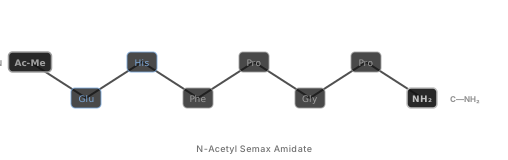
Adamax is N-Acetyl Semax Amidate — a structurally enhanced derivative of Semax, which itself is a synthetic analog of the ACTH (adrenocorticotropic hormone) 4-10 fragment. Semax was originally developed at the Institute of Molecular Genetics of the Russian Academy of Sciences in the 1980s and has been used in Russia as a prescription neuroprotective agent. Adamax takes the Semax peptide and adds two key modifications: an N-acetyl group at the amino terminus and an amide group at the carboxyl terminus.
These modifications serve a specific purpose: they protect the peptide from enzymatic degradation by aminopeptidases and carboxypeptidases, respectively. The result is a compound with significantly improved stability and bioavailability compared to standard Semax — making it a more potent and longer-lasting research tool for studying the neurotrophic and cognitive-enhancing properties of this peptide family.
📡 Weekly peptide research updates — regulatory updates, new compound profiles, COA alerts.
⚠️ FDA PCAC: -- days leftNo spam. Unsubscribe anytime. 7 peptides under review — see what's at stake →
Adamax sits at the intersection of several active areas of neuroscience research: neurotrophic factor modulation, cognitive enhancement, and neuroprotection. Its enhanced stability over standard Semax makes it particularly attractive for controlled research protocols.
7 free research tools built around exactly this kind of compound data. No paywall, no credit card.
Adamax operates through several interconnected mechanisms, all rooted in its parent compound Semax's activity as an ACTH 4-10 fragment analog. At the molecular level, it interacts with melanocortin receptors (primarily MC3 and MC4 subtypes), which are expressed throughout the central nervous system in regions associated with cognition, attention, and memory.
The most significant downstream effect is the upregulation of neurotrophic factors — particularly BDNF and NGF. BDNF is a key driver of synaptic plasticity, the process by which neural connections strengthen or weaken in response to experience. Increased BDNF expression is associated with enhanced long-term potentiation (LTP), the cellular mechanism widely considered the foundation of learning and memory formation.
Additionally, research has documented Semax-family peptides modulating dopaminergic and serotonergic neurotransmission, which contributes to effects on attention, motivation, and mood regulation observed in preclinical models. The compound also shows antioxidant properties through modulation of gene expression related to oxidative stress response, contributing to its neuroprotective profile.
If your brain's neural pathways are like a road network, BDNF is the construction crew that builds new roads and maintains existing ones. Most nootropic compounds try to make traffic move faster on existing roads (stimulants) or reduce traffic jams (anxiolytics). Adamax works more like increasing the construction budget — it tells your brain to build and maintain more neural infrastructure, which is why its effects are more about long-term capacity than immediate stimulation.
The Semax research literature spans over three decades, primarily from Russian research institutions, with increasing international attention. Key areas include:
All research referenced is published in peer-reviewed scientific literature and involves laboratory/animal models unless otherwise noted. This content is for educational purposes only and does not constitute medical advice.
⚠️ Research Use Only — the following is drawn exclusively from published scientific literature and does not constitute medical advice.
Semax-family peptide research protocols in published literature have used a range of dose levels and administration routes. The following reflects what has appeared in the research record:
The safety literature on Semax-family peptides is among the more extensive for nootropic neuropeptides, benefiting from decades of clinical use in Russia:
Safety information is drawn from published peer-reviewed literature on Semax and structural analogs. For research use only. Not for human or veterinary administration.
Semax — Adamax's parent compound — is one of the few nootropic peptides that made it to prescription drug status anywhere in the world. Approved in Russia in 2011 for conditions involving cognitive impairment and cerebrovascular disorders, it's prescribed as a nasal spray. Most research peptides never leave the lab; Semax graduated to the pharmacy shelf.
The ACTH 4-10 fragment that Semax is based on was discovered to have cognitive effects completely independent of ACTH's primary job (stimulating cortisol release from the adrenal glands). Scientists realized that chopping the hormone down to just 7 amino acids stripped away the endocrine effects while preserving — and even enhancing — the nootropic activity. It's one of the clearest examples of a "peptide within a peptide" in neuroscience.
Standard Semax has a plasma half-life of roughly 2-3 minutes — even shorter than many unstable peptides. The entire development of Adamax (N-Acetyl Semax Amidate) is essentially an engineering solution to one problem: how do you keep a molecule active long enough to study it properly when the body is determined to break it down almost immediately? The N-acetyl cap blocks one end, the amide cap blocks the other — like putting protective covers on both ends of a USB cable.
When evaluating third-party testing documentation for Semax-based analogs like Adamax, researchers should look for the following in any Certificate of Analysis: