⚖️
2026 Regulatory Update — PCAC Hearing July 24
Semax is on the FDA's 2026 PCAC agenda for Day 2 of the July hearings (July 24, 2026) — evaluated alongside Epitalon and DSIP/Emideltide. This follows the April 2026 Category 2 removal that affected Semax and several other peptides simultaneously.
Regulatory Timeline
Pre-2026
Semax classified under FDA Category 2 — bulk substances deemed to present safety risks, prohibited for compounding pharmacy use.
Apr 15, 2026
FR Doc. 2026-07361 (Docket FDA-2025-N-6895) removes Semax from Category 2. The explicit compounding prohibition is lifted — but this does not authorize compounding. Semax remains off the 503A Bulk Drug Substances List.
Jul 9, 2026
Public comment deadline for the PCAC docket covering Semax, Epitalon, and DSIP/Emideltide. Researchers and clinicians may submit evidence before the hearing.
Jul 24, 2026
FDA Pharmacy Compounding Advisory Committee (PCAC) Day 2 hearing. Semax, Epitalon, and DSIP/Emideltide evaluated for potential inclusion on the 503A Bulk Drug Substances List. PCAC is advisory — its recommendations require subsequent FDA rulemaking to take effect.
Late 2026
PCAC formal recommendations published. A positive recommendation initiates FDA rulemaking — not immediate authorization of compounding use.
2027
Estimated implementation window if FDA completes rulemaking following a positive PCAC recommendation.
Semax's Unique Position in This Hearing
Unlike most peptides before the PCAC, Semax has prescription pharmaceutical status in Russia (since 2011) — a unique advantage when presenting human safety data to the committee. Most research peptides rely entirely on animal studies; Semax has real-world clinical use data, though regulatory systems differ substantially. Whether the committee weighs this favorably is uncertain, but it does differentiate Semax's evidentiary record from most of its peers in this hearing.
Political context: The MAHA/RFK Jr. environment has elevated public attention to peptide regulatory access. The PCAC process is formal and evidence-based. Political attention shapes prioritization and timing; it does not predetermine committee conclusions. A positive PCAC recommendation is not guaranteed, and even a positive outcome requires the FDA rulemaking process before compounding becomes legally authorized.
Semax remains Research Use Only on this platform. Regulatory changes to compounding pharmacy rules do not affect RUO research access.
📡 Weekly peptide research updates — regulatory updates, new compound profiles, COA alerts.
⚠️ FDA PCAC: -- days left
No spam. Unsubscribe anytime. 7 peptides under review — see what's at stake →
🔬
What is it?
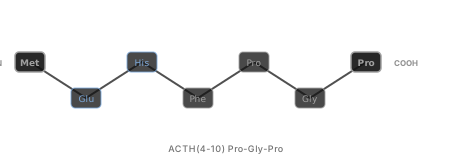
Semax is a synthetic heptapeptide — seven amino acids long — engineered as a stabilized analog of the ACTH(4-10) fragment of adrenocorticotropic hormone. Its full sequence is Met-Glu-His-Phe-Pro-Gly-Pro (MEHFPGP), with a molecular weight of approximately 887.0 Da. It was developed in the 1980s at the Institute of Molecular Genetics of the Russian Academy of Sciences by a team led by Dr. Nikolai Myasoedov, with the goal of creating a neurologically active ACTH derivative that retains the cognitive properties of the parent fragment without triggering the adrenal cascade associated with full ACTH administration.
The critical structural difference between Semax and the natural ACTH(4-10) fragment is the appended Pro-Gly-Pro tripeptide at the C-terminus. This addition dramatically increases the peptide's resistance to enzymatic degradation — standard ACTH(4-10) is cleared within seconds; Semax survives long enough to exert meaningful biological effects. It achieved prescription pharmaceutical status in Russia in 2011 and is prescribed as a nasal spray for stroke recovery and cognitive conditions, making it one of a small handful of synthetic nootropic peptides to cross the regulatory threshold anywhere in the world.
Semax is the parent compound of the Adamax derivative family. Adamax (N-Acetyl Semax Amidate) extends Semax further by adding N-acetyl and C-terminal amide modifications, improving stability and potency beyond what the Pro-Gly-Pro C-terminal extension alone achieves.
⚡
Why Researchers Care
Semax sits at an unusual intersection: it has one of the strongest research bodies of any synthetic nootropic peptide (over three decades of primarily Russian-language literature), it achieved actual pharmaceutical approval in at least one country, and it operates through mechanisms — neurotrophic factor modulation and melanocortin receptor interaction — that are distinct from stimulant, cholinergic, or GABAergic approaches to cognition research.
- BDNF and NGF upregulation: Semax has been shown in multiple preclinical studies to increase expression of both Brain-Derived Neurotrophic Factor and Nerve Growth Factor in the hippocampus and cortex — the primary growth signals governing neuronal maintenance, synaptogenesis, and long-term potentiation
- TrkB receptor activation pathway: The downstream mechanism of BDNF involves binding to TrkB (tropomyosin receptor kinase B), which triggers phosphorylation cascades associated with synaptic strengthening and neuronal survival — making Semax a tool for studying this pathway's role in cognition
- Melanocortin system modulation: ACTH fragment peptides interact with MC3 and MC4 melanocortin receptors in the CNS, which are linked to attention, motivation, and cognitive processing — providing a mechanistic basis separate from neurotrophic effects
- Neuroprotective evidence: Published work in cerebral ischemia models documents reduced infarct size, improved neurological scores, and decreased apoptotic cell death following Semax administration — supporting its use as a research tool in neuroprotection studies
- Prescription precedent: Clinical use in Russia since 2011 provides a unique layer of human safety data that most research peptides entirely lack — giving researchers a real-world reference point beyond animal models
⚙️
How It Works
Semax acts through multiple overlapping pathways that collectively shift the brain toward a more neurotrophically active, neuroprotective state. Unlike stimulants (which release or mimic neurotransmitters) or nootropics that modulate receptor sensitivity, Semax appears to operate primarily at the gene expression level — influencing which proteins the brain produces rather than directly competing for receptor binding sites.
Primary pathway — Neurotrophic factor upregulation: Semax increases BDNF and NGF gene expression, particularly in the hippocampus. BDNF binds to TrkB receptors, activating MAPK/ERK and PI3K/Akt signaling cascades. These pathways regulate neuronal survival, synaptic plasticity (via AMPA receptor trafficking), and long-term potentiation — the cellular mechanism underlying memory consolidation. NGF independently supports cholinergic neuron maintenance, relevant to learning and attention circuits.
Secondary pathway — Melanocortin receptor interaction: As an ACTH fragment, Semax retains partial agonist activity at MC3 and MC4 receptors in the CNS. These receptors modulate dopaminergic and serotonergic neurotransmission, attention processing, and energy homeostasis. MC4 activation in the hippocampus and prefrontal cortex is associated with improved working memory and attention in preclinical models.
Tertiary effects — Gene expression modulation and antioxidant activity: Transcriptomic studies have shown Semax modulates hundreds of genes including those governing vascular function, oxidative stress response, and immune signaling. The antioxidant gene expression changes are thought to contribute significantly to its neuroprotective effects in ischemia models by limiting reactive oxygen species damage during and after blood flow disruption.
Think of it like this 🧠
Most nootropics work like adjusting the volume knob on a radio — turning up dopamine, turning down GABA, changing the signal strength on pathways that already exist. Semax works more like upgrading the speakers themselves: it signals the brain to produce more of the structural proteins (BDNF, NGF) that determine how many neural connections can be maintained and how strong they can become. Volume adjustment is faster and more predictable; speaker upgrades take longer but change the ceiling of what's possible.
📊
Research Summary
The Semax literature spans over 35 years with primary origination from Russian academic and pharmaceutical institutions, and growing international research interest since the 2010s. Key documented areas:
- BDNF/NGF upregulation: Dolotov et al. (2006) in Journal of Molecular Neuroscience documented dose-dependent BDNF and NGF increases in rat hippocampus following intranasal Semax. Effects were most pronounced in hippocampal CA1 and CA3 regions — the primary zones for spatial memory encoding. The magnitude of BDNF upregulation in high-dose groups reached 2–3x baseline in some measurements.
- Cognitive enhancement in preclinical models: Multiple studies using Morris water maze (spatial learning), passive avoidance (aversive conditioning), and novel object recognition protocols have documented improved performance following Semax administration. Improvements correlated with hippocampal BDNF increases, suggesting neurotrophic factor upregulation as the mechanistic driver rather than stimulant-type arousal.
- Neuroprotection in ischemia models: Significant published work documents Semax's neuroprotective effects in transient global ischemia and focal cerebral ischemia models. Reviewed by Merzlyak et al. (2006) and later work, findings include reduced infarct volumes by 30–40% in some models, improved behavioral recovery scores, and decreased TUNEL-positive (apoptotic) cells in perilesional zones. This body of work directly informed its clinical approval for stroke recovery in Russia.
- Gene expression profiling: Transcriptomic analysis published by Agapova et al. (2007) in Neurochemical Research examined Semax's effect on gene expression across multiple brain regions, identifying modulation of 500+ genes including those involved in immune response regulation, oxidative phosphorylation, vascular tone, and synaptic protein expression. This broad regulatory footprint is considered both mechanistically interesting and a caution flag for interpreting single-outcome studies.
- EEG and brain activity studies: Electrophysiological research has documented Semax-induced changes in EEG power spectra, particularly increases in alpha and beta band activity in frontal regions — consistent with enhanced attentional engagement and working memory activation. These real-time electrophysiology measurements provide a bridge between behavioral outcomes and neural mechanism.
- Russian clinical data: Post-approval clinical monitoring and published case series from Russian neurological centers document use in stroke recovery, ischemic optic neuropathy, and certain cognitive impairment conditions. While this data doesn't meet Western RCT standards, it provides real-world safety and preliminary efficacy signals at the population level that preclinical research cannot.
All referenced research involves laboratory/animal models or approved clinical use in Russia unless otherwise noted. Content is for educational purposes only and does not constitute medical advice.
🧪
Literature Dosing Protocols
⚠️ Research Use Only — the following is drawn exclusively from published scientific literature and does not constitute medical advice.
Published research protocols for Semax have used a range of dose levels and administration routes depending on the research question. The following reflects what has appeared in the peer-reviewed record:
Preclinical Dose Range
50–300 µg/kg
Most cognitive enhancement studies in rodent models; intranasal or subcutaneous routes
Russian Clinical Formulation
0.1% nasal solution
Prescribed as drops/spray; dose per application varies by indication per Russian prescribing guidelines
Administration Route
Intranasal / Subcutaneous
Intranasal preferred for CNS access via olfactory pathway; SC used in pharmacokinetic studies
Plasma Half-Life
~2–7 minutes
Short systemic half-life; Pro-Gly-Pro extension provides stability vs. native ACTH(4-10) but remains rapidly cleared
Note: Semax's short plasma half-life is the primary reason for the development of Adamax (N-Acetyl Semax Amidate), which adds N-acetyl and amide terminus modifications to substantially extend active exposure time. Researchers comparing the two compounds should account for this stability difference in protocol design.
🛡️
Safety & Side Effect Profile
Semax benefits from an unusually large safety reference base for a nootropic peptide — both from decades of preclinical research and from post-approval clinical monitoring in Russia since 2011:
- Favorable preclinical tolerability: Across decades of rodent and primate studies, Semax has not demonstrated significant organ toxicity at doses used for cognitive and neuroprotective research. Acute and subchronic toxicity profiles from Russian regulatory submissions (available in Russian literature) indicate a favorable therapeutic index
- No dependence potential documented: Unlike stimulant nootropics (amphetamine-class) or GABA modulators, Semax has not demonstrated tolerance development, withdrawal syndrome, or reinforcing properties in preclinical models. Its mechanism (upregulating endogenous neurotrophic factors rather than directly stimulating reward circuits) is consistent with this absence of dependence signals
- Clinical safety signals from Russia: Approved clinical use since 2011 provides pharmacovigilance data from real-world prescribing. Published case series and clinical review articles from Russian neurology centers report transient irritation at the nasal application site as the most common adverse effect; serious adverse events have not been prominently documented in the available literature
- Melanocortin receptor activity considerations: MC3/MC4 activation by ACTH-fragment peptides carries potential downstream effects on appetite regulation, energy expenditure, immune modulation, and pigmentation — though these effects appear minimal at typical research doses used for cognitive studies. Researchers designing longer-duration protocols should monitor for these effects
- Rapid clearance as a safety factor: The short plasma half-life (2–7 minutes) means systemic exposure is self-limiting — an inherent safety property compared to compounds with prolonged half-lives. This is also the trade-off that drove development of the longer-acting Adamax derivative
- Research gap — long-term high-dose data: While short- and medium-term data is relatively well-established, high-dose or multi-year administration data outside clinical use is sparse. Researchers designing extended protocols should design appropriate monitoring endpoints
Safety information is drawn from published peer-reviewed literature and publicly available clinical information on Semax's approved use in Russia. For research use only. Not for human or veterinary administration.
✨
Fun Facts
🏥
Semax is one of the very few synthetic research peptides to have cleared regulatory approval anywhere in the world. Russia approved it as a prescription nasal spray in 2011 for stroke recovery and cognitive conditions. Most synthetic peptides remain exclusively in the preclinical research stage indefinitely — Semax is one of the rare compounds that cleared the clinical finish line.
🧬
The ACTH 4-10 fragment was discovered to have cognitive effects completely independent of ACTH's primary job — telling the adrenal glands to release cortisol. The scientists who created Semax recognized that by isolating this fragment and adding the Pro-Gly-Pro stabilizer tail, they could get the brain-specific effects of ACTH while bypassing the entire hormonal cascade. It's one of the clearest examples of "fragmenting" a hormone to isolate just the CNS activity.
🧠
Semax has been studied using EEG (electroencephalography) — real-time brain activity measurement — to track its effects on neural oscillations. Researchers documented shifts in alpha and beta wave power in frontal regions, consistent with changes in attentional engagement. This direct electrophysiological window is unusual for research peptides, most of which are evaluated only through behavioral outcomes or post-sacrifice tissue analysis.
🧬
COA Standards & What to Look For
When evaluating third-party testing documentation for Semax, researchers should verify the following in any Certificate of Analysis:
- Sequence confirmation and HPLC purity: Semax (MEHFPGP) should be confirmed by HPLC with purity ≥98% for research-grade material. Critically, the COA should specify the compound is the ACTH-fragment analog with Pro-Gly-Pro C-terminus extension — not truncated fragments or N-acetyl/amide modifications (which would indicate Adamax, not Semax)
- Mass spectrometry: LC-MS or MALDI-TOF confirmation of the correct molecular weight (~887.0 Da) is essential. The mass spec should be consistent with the MEHFPGP heptapeptide structure specifically — verifying you have Semax and not a structurally adjacent compound
- Residual solvents panel: Peptide synthesis involves organic solvent exposure (DMF, DCM, TFA, acetonitrile). A complete COA should include a residual solvent panel confirming USP/ICH Class 1 and 2 thresholds are met
- Counter-ion specification: Research-grade Semax is typically supplied as the trifluoroacetate (TFA) salt from HPLC purification. Some suppliers convert to acetate salt form. The COA should specify the counter-ion as it affects actual peptide content per unit mass
- Endotoxin testing: Lyophilized Semax intended for reconstitution and injectable research protocols should include endotoxin testing (LAL/BET method) confirming levels below 1 EU/mg for in vivo use
📄
HPLC Certificate
Documentation pending batch assignment
🔬
Mass Spec Analysis
Documentation pending batch assignment
✅
Purity Report
Documentation pending batch assignment
🧪
Sterility Test
Documentation pending batch assignment
Learn about our COA verification process →