🔬
What is this stack?
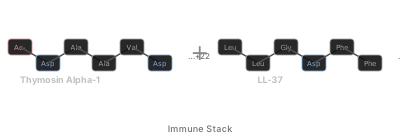
This is the immune system's two-front research model: Thymosin Alpha-1 working on adaptive immunity (the specialized, learned immune response), and LL-37 working on innate immunity (the immediate, non-specific first-line defense). These two arms of the immune system normally operate in coordination, and researchers study whether supporting both simultaneously produces more comprehensive immune outcomes in models of immune dysfunction.
Thymosin Alpha-1 is a 28-amino-acid peptide naturally produced by the thymus gland — the small organ in the chest responsible for T-cell maturation and education. It's been studied for over 40 years and is one of the most clinically advanced immune peptides available, approved as Zadaxin in more than 35 countries for various immune-related indications. Its research focus is primarily on T-cell differentiation, NK cell activity, dendritic cell function, and the regulation of cytokine responses — all adaptive immune functions.
LL-37 is the only human cathelicidin — a member of the antimicrobial peptide family that forms part of the innate immune system's first-line defense. It's produced naturally by neutrophils, macrophages, NK cells, and even skin cells. Its research covers direct antimicrobial activity (disrupting bacterial membranes), immunomodulatory effects (activating innate immune signaling), wound healing, and angiogenesis. It bridges innate immunity with signaling that affects adaptive immune function as well.
📡 Weekly peptide research updates — regulatory updates, new compound profiles, COA alerts.
⚠️ FDA PCAC: -- days left
No spam. Unsubscribe anytime. 7 peptides under review — see what's at stake →
⚡
How They Work Together
The fundamental research interest in this combination is that it covers both major immune system branches through their respective regulatory peptides:
- Thymosin Alpha-1 operates primarily through TLR (Toll-like receptor) signaling and cytokine regulation — specifically, it promotes Th1 immune responses (cell-mediated immunity, important for viral and intracellular pathogen defense), dendritic cell maturation, and NK cell cytotoxicity. It's fundamentally a regulator of immune system orchestration.
- LL-37 operates through multiple mechanisms: direct membrane disruption of pathogens, activation of pattern recognition receptors (TLR2, TLR4), neutrophil and macrophage recruitment and activation, and pro-inflammatory signaling that accelerates the innate immune response.
Think of it like this 🧠
Imagine the immune system as a military organization. Thymosin Alpha-1 is the strategic command — it trains and coordinates the specialized forces (T-cells, NK cells, dendritic cells), improves their readiness and communication, and makes sure the adaptive response is well-organized when threats are identified. LL-37 is the rapid deployment unit — when pathogens breach the perimeter, it shows up immediately, disrupts enemy formations directly, sounds the alarm to bring in reinforcements, and starts the wound-repair process at the breach site. Good strategy without rapid response fails at first contact. Rapid response without strategy succeeds locally but can't handle complex threats. The combination covers both.
📖
Why Researchers Pair These
- Innate + adaptive coverage: Most immune research focuses on either innate or adaptive immunity. This pairing allows simultaneous study of both arms — particularly relevant in research models examining comprehensive immune modulation rather than a single pathway.
- TLR pathway from two directions: Both compounds influence Toll-like receptor signaling, but from different entry points. Thymosin Alpha-1 modulates TLR9 (DNA pattern recognition, viral defense) and downstream cytokine regulation. LL-37 modulates TLR2 and TLR4 (bacterial pattern recognition). Researchers study whether dual TLR activation via different pathways produces synergistic innate immune activation.
- Immune aging research: The thymus naturally involutes (shrinks) with age, leading to reduced T-cell output and immune competence. Thymosin Alpha-1 is studied for thymic restoration in aging immune models. LL-37 levels are also known to decline with age and in certain chronic conditions. Together, they're studied in immune aging and restoration research models.
- Infection model research: In preclinical infection models, Thymosin Alpha-1 has been studied for enhancing adaptive immune responses to viral and bacterial pathogens, while LL-37 is studied for direct antimicrobial activity and innate immune amplification. The combination is studied in models examining how adaptive preparation and innate response interact.
- Cytokine balance research: Both compounds have been studied for their effects on inflammatory cytokine balance — Thymosin Alpha-1 for promoting appropriate Th1/Th2 balance, LL-37 for modulating macrophage and dendritic cell cytokine profiles. Researchers examine whether dual cytokine modulation achieves better inflammatory resolution in tissue models.
Explore each compound's standalone research profile for full mechanism breakdowns, published study summaries, and COA documentation:
✨
Fun Facts
🏭
Thymosin Alpha-1 has one of the most extensive clinical research histories of any peptide in this library — it's been studied in clinical trials for hepatitis B, hepatitis C, cancer, and sepsis. Its approval as Zadaxin in more than 35 countries represents a rare level of regulatory validation for a peptide compound, and provides a strong safety and efficacy research foundation.
🧬
LL-37 is the only cathelicidin that humans produce — most mammals have multiple cathelicidins, but humans evolved with just one, suggesting it plays a uniquely important and non-redundant role in human innate immunity. Its structure includes a positively charged amphipathic helix that disrupts negatively charged bacterial membranes — essentially punching holes in bacterial cells at close range.
📉
The thymus is most active during childhood and early adolescence, when it produces the T-cells that seed the body's adaptive immune system. By middle age, much of the thymus has been replaced by fat tissue in a process called thymic involution. This is one reason immune function declines with age — the T-cell production factory gradually shuts down. Thymosin Alpha-1 research explores whether the remaining thymic tissue can be stimulated to maintain output.