🔬
What is this stack?
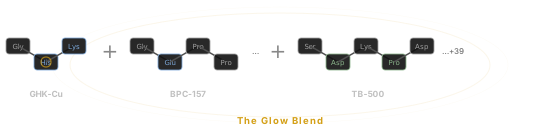
The Glow Blend layers three well-characterized regenerative peptides into a single Anti-Aging research protocol, each operating at a distinct level of cellular biology:
GHK-Cu (Glycyl-L-Histidyl-L-Lysine copper complex) is a naturally occurring tripeptide first isolated from human plasma in the 1970s. It has since been studied for its remarkable capacity to modulate gene expression at scale — research has suggested it influences the activity of over 4,000 human genes, including those governing collagen and elastin synthesis, metalloproteinase (MMP) regulation, DNA repair, antioxidant defense, and anti-inflammatory signaling. Plasma levels of GHK-Cu decline significantly with age, a finding that has made it a focus of longevity and skin-aging research.
BPC-157 (Body Protection Compound-157) is a 15-amino-acid synthetic peptide derived from a protective gastric protein. It has been studied across a wide range of tissue types — tendon, ligament, muscle, gut, cornea, and skin — for its pro-healing, pro-angiogenic, and anti-inflammatory properties. BPC-157 is particularly studied for its ability to accelerate new blood vessel formation (angiogenesis) via VEGF pathways, which is required for the delivery of oxygen and nutrients to regenerating tissue.
TB-500 (Thymosin Beta-4) is a 43-amino-acid peptide that acts as the primary regulator of actin polymerization in cells. Actin dynamics are fundamental to cell migration, proliferation, and differentiation — the three cellular processes that drive wound repair and tissue regeneration at scale. Unlike BPC-157's localized effects, TB-500's mechanism is systemic: it distributes broadly through tissue and promotes cell migration across large areas of the body simultaneously, making it studied as a complement to BPC-157's more targeted local action.
Together, these three compounds are studied by researchers as a triple-mechanism anti-aging stack: gene-level reprogramming (GHK-Cu) + localized signaling activation (BPC-157) + systemic cell migration facilitation (TB-500).
📡 Weekly peptide research updates — regulatory updates, new compound profiles, COA alerts.
⚠️ FDA PCAC: -- days left
No spam. Unsubscribe anytime. 7 peptides under review — see what's at stake →
⚡
How All Three Work Together
The research rationale for combining all three lies in non-overlapping mechanisms that address tissue aging from three different scales:
Layer 1 — Gene Expression (GHK-Cu): Age-related tissue degradation partly reflects shifts in gene expression — the cell population is still there but reading the wrong instructions. GHK-Cu research suggests it can shift gene expression profiles toward a more regenerative baseline: upregulating collagen and elastin synthesis genes, activating antioxidant defense genes (SOD, catalase, GPx), downregulating inflammatory cytokines, and modulating MMP activity to enable controlled breakdown of damaged extracellular matrix before new matrix is laid down. This gene-level effect is upstream of everything else — it changes what the cell is being instructed to do before other signals arrive.
Layer 2 — Local Repair Signaling (BPC-157): Within a specific tissue site that's been damaged or degraded, BPC-157 creates the repair signaling environment: VEGF upregulation to grow new capillaries, growth hormone receptor sensitization on local fibroblasts (which are the cells that produce collagen), nitric oxide modulation to regulate local blood flow, and anti-inflammatory cytokine effects that prevent the chronic inflammation state that disrupts healing. BPC-157 works at the site level — it addresses the specific locale where regeneration is needed.
Layer 3 — Systemic Cell Deployment (TB-500): New tissue requires not just instructions and signals but cells — specifically, progenitor cells and repair-specialized cells that have to migrate from distant reservoirs to the repair site. TB-500's primary mechanism is sequestering G-actin to regulate actin dynamics, which controls how cells move through tissue. When actin polymerization is optimized for migration, cells travel to repair sites more efficiently. TB-500 is studied in models of injury where the quantity and speed of cell migration determines whether repair completes properly — skin wounds, tendon injuries, cardiac damage. In the anti-aging context, it addresses the question of whether aged tissue fails to regenerate partly because cells can no longer migrate effectively to where they're needed.
Think of it like this 🧠
Imagine restoring an aging building complex. GHK-Cu is the updated building code — a regulatory revision that changes the standards every contractor in the district must follow. Better materials, higher structural requirements, stricter fire safety. Every future construction project in the area now operates under better rules. This affects every building being repaired or maintained. BPC-157 is the master builder assigned to the specific most-damaged building — calling in the supply trucks (new blood vessels), managing the on-site repair crew, calling for the right materials, and ensuring the restoration plan is executed locally. TB-500 is the logistics network that gets the skilled workers to the site — the infrastructure that routes qualified workers from wherever they are across the city to wherever they're needed most. Better building codes plus on-site management plus efficient worker routing means the restoration is faster, higher quality, and covers more of the complex simultaneously.
📖
Why Researchers Study This Combination
- Anti-aging at three levels simultaneously: Aging tissue fails at multiple levels — gene expression shifts away from maintenance, local repair signaling becomes dysregulated, and cells lose motility. A single compound that addresses one level may produce partial results; the three-compound stack addresses all three levels in parallel. Researchers study whether multi-level coverage produces qualitatively different outcomes in aged tissue models versus single-mechanism approaches.
- Collagen synthesis from three different angles: GHK-Cu upregulates collagen synthesis genes. BPC-157 promotes angiogenesis that supplies oxygen and growth factors required for collagen-producing fibroblasts. TB-500 facilitates fibroblast migration to the repair site. Each supports collagen production at a different point in the process: instructions, environment, and cell arrival. Researchers study whether triple-mechanism collagen support produces measurably different matrix organization than single-peptide protocols.
- MMP regulation vs. angiogenesis vs. cell migration: These are three mechanistically independent variables in tissue repair. GHK-Cu regulates MMPs (controlling whether old matrix gets broken down properly before new matrix is built). BPC-157 drives angiogenesis (controlling whether the vascular supply to the repair site is adequate). TB-500 drives cell migration (controlling whether enough repair-competent cells arrive). These don't substitute for each other — they address different rate-limiting steps in the same process.
- Broad tissue type coverage: GHK-Cu has deep research in skin, wound, and hair follicle contexts. BPC-157 has research across tendon, ligament, gut, cornea, and skin. TB-500 has research in tendon, cardiac, CNS, and skin. Together, the tissue research base spans essentially every major tissue type, making the combination studied in multi-tissue aging models where no single compound had precedent across all tissues studied simultaneously.
- Anti-inflammatory convergence via different pathways: All three compounds have studied anti-inflammatory effects, but through different mechanisms: GHK-Cu via gene expression of inflammatory genes, BPC-157 via NF-kB and COX-2 pathway modulation, TB-500 via downstream actin regulation effects on inflammatory cell infiltration. Triple-mechanism inflammation control is studied for whether it reduces the chronic low-grade inflammation (inflammaging) that is a hallmark of tissue aging.
- BPC-157 + TB-500 as a proven baseline: The BPC-157 + TB-500 Recovery Stack has substantial research as a two-compound protocol (see the Recovery Stack page). The Glow Blend adds GHK-Cu's gene expression layer to that established foundation — researchers study whether the upstream gene-level effects of GHK-Cu add to the established efficacy of the BPC-157 / TB-500 pairing in regenerative models.
📊
Mechanism Comparison: The Three Layers
| Compound |
Scale |
Primary Mechanism |
Key Anti-Aging Effect |
| GHK-Cu |
Genomic |
Gene expression modulation (4,000+ genes) |
Collagen/elastin gene upregulation, antioxidant gene activation, MMP regulation |
| BPC-157 |
Local |
Signaling cascade activation (VEGF, GH receptor, NO) |
Angiogenesis, fibroblast activation, tissue repair environment |
| TB-500 |
Systemic |
Actin sequestration → cell migration regulation |
Broad cell migration to repair sites, proliferation, differentiation |
All research is preclinical unless otherwise noted. Cross-compound synergy is studied in vitro and in animal models; human clinical trials on this specific combination have not been conducted.
Each compound in the Glow Blend has a full standalone research profile covering mechanism, published studies, and COA documentation:
🥇
GHK-Cu
Copper tripeptide — gene expression modulation (4,000+ genes), collagen synthesis, MMP regulation, antioxidant activation, skin remodeling, wound healing research
→
🧬
BPC-157
Body Protection Compound — localized tissue repair, VEGF-mediated angiogenesis, growth hormone receptor upregulation, nitric oxide modulation, multi-tissue research
→
🪐
TB-500 (Thymosin Beta-4)
Actin sequestration — systemic cell migration, proliferation, differentiation; wound repair acceleration, tendon and cardiac research; broader tissue coverage than BPC-157
→
✨
Fun Facts
🧬
GHK-Cu was discovered by Loren Pickart in the 1970s during liver regeneration research — he noticed that young human plasma restored aged liver function, and traced it to a small tripeptide. Decades later, research confirmed it could modulate thousands of genes simultaneously, making it one of the most gene-active small peptides ever discovered.
🪐
TB-500 (Thymosin Beta-4) was first identified in research examining why certain tissue types — including cardiac tissue — responded so well to regenerative interventions. The key turned out to be actin regulation: cells with optimized actin dynamics migrate faster and more accurately to repair sites. TB-500 is now studied in cardiac repair models precisely because heart tissue has very limited regenerative capacity and cell migration quality matters enormously.
🔬
The BPC-157 + TB-500 pairing (already in the Axis library as the Recovery Stack) is one of the most studied peptide combinations in preclinical regenerative research. Adding GHK-Cu's genomic layer to that established two-compound base is the core research rationale of the Glow Blend — gene-level instruction plus environmental signaling plus logistical cell deployment, studied together in anti-aging tissue models.
📋
COA & Batch Documentation
Every batch of the Glow Blend (GHK-Cu + BPC-157 + TB-500) with full Certificate of Analysis documentation for each component.
📄
HPLC Certificate
Documentation pending batch assignment
🔬
Mass Spec Analysis
Documentation pending batch assignment
✅
Purity Report
Documentation pending batch assignment
🧪
Sterility Test
Documentation pending batch assignment
Learn about our COA verification process →