🔬
What is it?
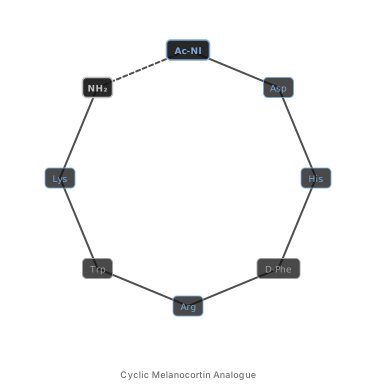
Melanotan II is a synthetic analog of alpha-melanocyte-stimulating hormone (α-MSH) — a naturally occurring hormone that plays a key role in pigmentation, appetite, and sexual function. Researchers at the University of Arizona developed it in the late 1980s by creating a cyclic version of α-MSH, which made it more stable in the body than the natural hormone.
The original research motivation was actually skin cancer prevention — the hypothesis was that if researchers could safely increase melanin production in the skin, it might provide natural UV protection. The research quickly revealed that Melanotan II activates not just the melanocortin-1 receptor (MC1R, which controls pigmentation) but also MC3R and MC4R, which are involved in energy balance, sexual function, and appetite regulation.
This broad receptor activation profile made Melanotan II one of the most informative tools for studying the entire melanocortin system — a network of receptors and signaling pathways that touches far more of the body's regulatory biology than early researchers anticipated. The compound became a reference standard for melanocortin pharmacology research.
Its cyclic structure is key to its utility: linear α-MSH is rapidly degraded in the body, making controlled research difficult. By cyclizing the peptide, the University of Arizona team created a compound stable enough to produce reliable, repeatable laboratory results over extended observation periods.
📡 Weekly peptide research updates — regulatory updates, new compound profiles, COA alerts.
⚠️ FDA PCAC: -- days left
No spam. Unsubscribe anytime. 7 peptides under review — see what's at stake →
⚡
Why Researchers Care
Melanotan II's ability to activate multiple melanocortin receptor subtypes simultaneously gives researchers a single tool to probe an entire regulatory network at once.
- Melanotan II's activation of multiple melanocortin receptors (MC1R, MC3R, MC4R) gives researchers a tool to study the entire melanocortin system — one of the body's most complex regulatory networks.
- Research on the melanocortin system has implications far beyond pigmentation — these receptors regulate feeding behavior, energy homeostasis, and inflammation, making them major drug development targets.
- Published studies have examined Melanotan II as a reference compound for understanding melanocortin receptor pharmacology — it's frequently used as a control or comparison compound in MC receptor research.
⚙️
How It Works
Melanotan II binds to and activates melanocortin receptors throughout the body. At MC1R, activation triggers melanin synthesis in melanocytes — the cells responsible for skin pigmentation — by activating the cAMP signaling cascade that drives melanin production. At MC3R and MC4R (found in the brain and hypothalamus), it influences appetite suppression and other neurological effects by modulating dopaminergic and noradrenergic signaling pathways. This multi-receptor activity is what gives Melanotan II its characteristic research profile: a single compound affecting multiple distinct physiological systems through a shared receptor family.
Think of it like this 🧠
The melanocortin system is like a building with multiple floors, each with its own control panel. MC1R is the basement (skin), MC3R is the second floor (metabolism), MC4R is the penthouse (brain and appetite). Melanotan II is like a master key that unlocks all the floors at once — useful for researchers who want to study what happens when the whole building gets activated simultaneously.
📐
Clinical Protocol Context
Research Disclaimer: The following reflects published clinical and preclinical research and is not medical advice. Consult a licensed healthcare provider before making any health decisions.
Melanotan II was studied in Phase I/II human clinical trials at the University of Arizona, yielding published dose-response data for both melanocyte stimulation and erectile function endpoints.
Dosing Ranges from Published Research
Phase I — Tanning
Hadley et al. (2000, Peptides) used 0.025 mg/kg SC in healthy volunteers. Melanocyte stimulation (increased skin pigmentation via reflectometry) was measurable at 0.025 mg/kg SC. Higher doses (0.05–0.1 mg/kg) produced greater pigmentation but increased side effects (nausea, facial flushing).
Phase II — Erectile Function
Wessells et al. (1998, J Urol) conducted a double-blind placebo-controlled trial using 0.025 mg/kg SC in men with psychogenic erectile dysfunction. Penile tumescence was measured by RigiScan device. The 0.025 mg/kg dose produced statistically significant responses in 80% of subjects.
Routes, Duration & Timing
SCSubcutaneous injection used in all published human trials. Effects measurable within 1–3 hours in erectile function studies.
Tanning TimelineSignificant melanocyte activation documented at 3–4 weeks of intermittent dosing in Arizona tanning trials. Half-life approximately 33 minutes; effects outlast plasma exposure due to receptor-level signaling cascades.
StorageLyophilized at −20°C. Reconstituted with bacteriostatic water. Light-sensitive; protect from UV exposure. Use reconstituted solution within days.
Key References: Hadley ME et al. (2000). Melanotan II in human subjects. Peptides. · Wessells H et al. (1998). Melanotan II in erectile dysfunction. J Urol. · Dorr RT et al. (1996). Melanocyte stimulating peptide clinical pharmacology. Br J Cancer.
✨
Fun Facts
🏜️
The original Melanotan research was funded in part by the goal of creating a "sunless tan" that could protect against Australia's high skin cancer rates — the project started as a practical public health initiative.
🔬
Melanotan II is structurally cyclic — meaning the chain is formed into a ring shape. This makes it significantly more resistant to degradation than the linear α-MSH it's based on, which has a very short half-life.
🎯
Melanocortin receptors are one of the most studied G-protein coupled receptor (GPCR) families in drug development — Melanotan II has been a key research tool in this field for over 30 years.
<\!-- COA & Batch Documentation -->
📋
COA & Batch Documentation
Every batch of Melanotan II with full Certificate of Analysis documentation. Third-party HPLC verification, mass spectrometry confirmation, and sterility testing results are included with each batch.
📄
HPLC Certificate
Documentation pending batch assignment
🔬
Mass Spec Analysis
Documentation pending batch assignment
✅
Purity Report
Documentation pending batch assignment
🧪
Sterility Test
Documentation pending batch assignment
Learn about our COA verification process →