🔬
What is the Klow Blend?
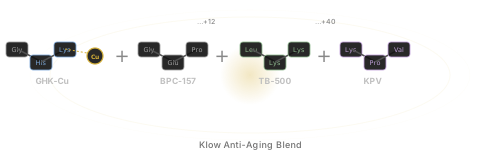
The Klow Blend is a four-compound peptide stack combining GHK-Cu (copper tripeptide-1), BPC-157 (body protection compound), TB-500 (thymosin beta-4 fragment), and KPV (Lys-Pro-Val). Each compound has its own well-documented research history — but the Klow Blend is studied for how these four mechanisms interact and potentially reinforce each other within a single research protocol.
What distinguishes this blend from simpler two-peptide stacks is the breadth of biological coverage. GHK-Cu is the gene-expression layer — it broadly reprograms what instructions cells are reading, influencing over 4,000 genes in published research. BPC-157 is the angiogenesis and localized repair layer — it recruits vasculature and sends direct repair signals to damaged tissue. TB-500 is the structural cell migration layer — it sequesters actin and promotes systemic cell movement toward injury sites. KPV is the anti-inflammatory resolution layer — an alpha-MSH-derived tripeptide studied for potent NF-κB inhibition and downstream inflammation shutdown.
In anti-aging research contexts specifically, this four-pronged approach reflects a systems-biology view of aging: it's not one mechanism failing, but an interrelated breakdown of gene expression, tissue repair capacity, cellular motility, and chronic inflammatory burden. The Klow Blend attempts to address all four at once.
⚡
The Four Mechanisms
Each compound in the Klow Blend operates at a distinct biological level:
GHK-Cu — Gene Expression Modulation (Upstream): GHK-Cu (Glycyl-L-Histidyl-L-Lysine copper complex) is a naturally occurring human tripeptide that binds copper and activates broad gene expression cascades. Investigación has documented its influence on collagen synthesis, elastin production, MMP (matrix metalloproteinase) regulation, antioxidant gene activation, and DNA repair pathway upregulation. It's essentially a transcription-level intervention — changing which genes cells are actively reading. In aging models, this is significant because gene expression dysregulation is a hallmark of cellular aging. GHK-Cu has been studied in skin, wound, hair follicle, and neuronal contexts.
BPC-157 — Angiogenesis & Localized Repair (Signaling): BPC-157 (Body Protection Compound-157) is a 15-amino-acid synthetic peptide derived from human gastric juice proteins. Its primary studied mechanisms include VEGF-mediated angiogenesis (blood vessel formation), upregulation of growth hormone receptors on fibroblasts, nitric oxide system modulation, and localized anti-inflammatory cytokine effects. Where GHK-Cu works at the gene expression level, BPC-157 works at the extracellular signaling level — creating a vascular and repair-friendly environment at specific tissue sites. It's studied across tendon, gut, muscle, nerve, and skin tissue in animal models.
TB-500 — Actin Sequestration & Systemic Cell Migration (Structural): TB-500 is a synthetic version of the actin-binding region of Thymosin Beta-4, a 43-amino-acid peptide naturally present in all nucleated mammalian cells. Its primary mechanism is G-actin sequestration — TB-500 binds to unpolymerized actin (G-actin), which simultaneously reduces cytoskeletal rigidity in injured cells and promotes directional cell migration toward wound sites. This mechanism is systemic, not localized: TB-500 facilitates cell mobilization across tissue types, making it studied as a complement to localized repair signals like BPC-157. It also independently promotes angiogenesis, though via different signaling than VEGF-dominant BPC-157 pathways.
KPV — Inflammation Resolution (Downstream): KPV (Lys-Pro-Val) is a naturally occurring C-terminal tripeptide fragment of alpha-Melanocyte Stimulating Hormone (α-MSH). Alpha-MSH is a well-characterized anti-inflammatory neuropeptide, and KPV retains its anti-inflammatory potency in a much smaller molecular package. KPV has been studied for NF-κB pathway inhibition — NF-κB is the master transcription factor driving inflammatory gene expression, including IL-1β, IL-6, and TNF-α. KPV also reduces macrophage activation and has been studied specifically in gut inflammation, wound healing, and skin inflammatory models. In anti-aging contexts, chronic low-grade inflammation (inflammaging) is considered a primary driver of tissue deterioration — KPV addresses this at the downstream resolution level.
Think of it like this 🧠
Imagine a city district after years of neglect. GHK-Cu is the new city code revision — it mandates better building standards at the planning level, so every new construction in the zone is required to use upgraded materials, maintain structural integrity, and prioritize longevity. These changes affect every building project in the district. BPC-157 is the targeted construction crew on the specific buildings that are damaged most urgently — they lay new pipes, restore the water supply (vasculature), and send the skilled tradespeople to the right addresses. TB-500 is the logistics network — it mobilizes workers from across the city toward the district, coordinates material supply routes, and ensures the construction crew can actually get to the job sites. KPV is the air quality board — it shuts down the factories producing the chronic smog (inflammatory signaling) that was slowly degrading every building in the district regardless of how well you repair them. Each layer is necessary; none fully substitutes for the others.
📖
Why Investigacióners Study This Combination
- Four independent entry points into tissue aging: The Klow Blend is studied because it doesn't redundantly hit the same pathway multiple times. Each compound enters the anti-aging biology at a different level: transcription (GHK-Cu), signaling (BPC-157), structural/migratory (TB-500), and inflammatory (KPV). Investigacióners studying comprehensive anti-aging models want coverage across all four layers rather than four-fold intensity at one layer.
- GHK-Cu + TB-500 collagen synergy: GHK-Cu upregulates collagen synthesis at the gene expression level; TB-500 reduces inflammatory interference with collagen deposition via its anti-inflammatory secondary effects; BPC-157 promotes vascularization that delivers the oxygen and nutrients collagen production requires. Three compounds converging on collagen quality and quantity from different angles — a key anti-aging tissue target.
- Dual angiogenesis pathways: Both BPC-157 and TB-500 promote angiogenesis, but via distinct mechanisms. BPC-157 acts primarily through VEGF receptor upregulation; TB-500 promotes actin reorganization in endothelial cells that enables vessel sprouting. Investigación on whether dual-mechanism angiogenesis produces more robust vascularization than either pathway alone is an active area in regenerative models.
- KPV addresses the "inflammaging" substrate: Chronic, low-grade inflammation (inflammaging) is now understood as a root mechanism of tissue aging — it impairs collagen quality, disrupts cellular signaling, and interferes with repair processes. Without resolving this inflammatory backdrop, repair compounds work less efficiently. KPV's NF-κB inhibition is studied as the resolution layer that clears the inflammatory substrate, allowing the repair signals from BPC-157 and structural mobilization from TB-500 to work more effectively.
- Complementary half-lives and administration windows: BPC-157, TB-500, and KPV have different stability profiles in biological models, which researchers consider when designing dosing windows. GHK-Cu's gene expression effects are studied as durable (lasting well beyond immediate peptide clearance), making it a different category of durability than the signaling and structural compounds alongside it. Investigacióners interested in sustained regenerative effects study whether GHK-Cu's transcript-level changes amplify the benefits of the other three.
- Gut-to-systemic axis: Both BPC-157 (with its gastric protein origins) and KPV have studied effects in gut tissue, including intestinal barrier function and mucosal healing in inflammatory bowel models. TB-500's systemic cell migration mechanisms and GHK-Cu's gene expression work in intestinal tissue add further coverage. The gut-immune axis is a recognized contributor to systemic aging; researchers study whether this blend provides gut-protective effects as part of its broader anti-aging profile.
📊
Investigación Dosing Context
The Klow Blend has been studied at combined daily doses of 1mg–2mg in research contexts, typically administered as a single combined preparation. The following is illustrative of how researchers have distributed doses across components — not a clinical recommendation of any kind:
| Compound |
Investigación Dose Range |
Primary Mechanism |
Investigación Notes |
| GHK-Cu |
200–500mcg |
Gene expression (4,000+ genes), collagen upregulation |
Studied subcutaneous and topical; topical penetration well-documented for skin models |
| BPC-157 |
250–500mcg |
VEGF angiogenesis, GH receptor upregulation, nitric oxide |
Studied in injectable and oral forms; gastric stability a notable research property |
| TB-500 |
500mcg–1mg |
G-actin sequestration, systemic cell migration, endothelial angiogenesis |
Larger molecule; often studied at higher relative doses than smaller peptides in the blend |
| KPV |
100–500mcg |
NF-κB inhibition, macrophage modulation, inflammation resolution |
Tripeptide with notable stability and mucosal bioavailability in research models |
All dosing information above is from published preclinical research only. This content is educational and for research use only. Not a clinical recommendation.
The 8–12 week on / 2–4 week off cycle protocol used in research reflects both practical washout considerations and the observed tissue remodeling timelines in animal models — collagen turnover and vascular remodeling operate on weeks-to-months timescales, making shorter protocols less informative for regenerative endpoints.
📊
Anti-Aging Investigación Context
Anti-aging peptide research has shifted in the past decade from single-molecule "silver bullet" thinking to systems-biology approaches that recognize aging as multi-mechanism. The hallmarks of aging framework (López-Otín et al., 2013, updated 2023) identifies interconnected drivers: genomic instability, telomere attrition, epigenetic alterations, loss of proteostasis, disabled macroautophagy, deregulated nutrient sensing, mitochondrial dysfunction, cellular senescence, stem cell exhaustion, altered intercellular communication, chronic inflammation, and dysbiosis. No single peptide addresses all of these — but research stacks like the Klow Blend attempt to address clusters of them simultaneously.
The four compounds in the Klow Blend map onto specific hallmarks:
- GHK-Cu — addresses epigenetic alterations (broad gene expression restoration), loss of proteostasis (collagen and ECM quality), and genomic instability (DNA repair gene upregulation in several studies).
- BPC-157 — addresses deregulated nutrient sensing pathways (GH receptor upregulation), altered intercellular communication (signaling normalization), and stem cell support (angiogenesis improves the stem cell niche).
- TB-500 — addresses stem cell exhaustion (mobilizes progenitor cells toward tissue repair sites), altered intercellular communication (actin-dependent signal transduction), and mitochondrial support in cardiomyocyte models.
- KPV — directly addresses chronic inflammation (inflammaging), which cross-amplifies most other aging hallmarks; also studied in cellular senescence reduction via inflammatory SASP (Senescence-Associated Secretory Phenotype) inhibition.
This mechanistic coverage across multiple hallmarks of aging is the core scientific rationale for the Klow Blend's design — four targeted interventions at four different nodes of the aging network.
Explore each compound's standalone research profile for full mechanism breakdowns, published study summaries, and COA documentation:
🌟
GHK-Cu
Copper tripeptide — 4,000+ gene expression modulation, collagen synthesis, MMP regulation, antioxidant activation, DNA repair, skin remodeling
→
🧬
BPC-157
Body Protection Compound — VEGF angiogenesis, localized tissue repair, GH receptor upregulation, nitric oxide modulation, gut-brain axis
→
👴
TB-500
Thymosin Beta-4 fragment — G-actin sequestration, systemic cell migration, endothelial angiogenesis, cardiac and musculoskeletal repair models
→
🔥
KPV
Alpha-MSH C-terminal tripeptide — NF-κB inhibition, macrophage modulation, gut mucosal healing, inflammation resolution, skin wound research
→
✨
Datos Interesantes
🧬
GHK-Cu's gene expression effects were first quantified by Loren Pickart and colleagues, but the full scale — over 4,000 human genes — wasn't appreciated until modern microarray and RNA sequencing studies. For a tripeptide (just three amino acids) to influence the transcription of that many genes is considered biologically extraordinary. The mechanism involves both receptor-mediated signaling and direct chromatin accessibility changes.
👴
TB-500 (Thymosin Beta-4) is found in every nucleated cell of the human body — it's one of the most abundant cytoplasmic proteins in mammals. Yet it wasn't recognized as a significant tissue repair signal until researchers noticed that wound fluid contains dramatically elevated concentrations immediately after injury. The body apparently already treats it as an emergency repair mobilization signal; TB-500 in research contexts is studied as an amplification of that endogenous response.
🔥
KPV was identified as the bioactive anti-inflammatory fragment of alpha-MSH through systematic N-terminal truncation studies. Investigacióners methodically shortened alpha-MSH (13 amino acids) and tested each fragment's potency — KPV turned out to retain most of the anti-inflammatory activity in just 3 amino acids. Small molecule size also gives it favorable mucosal bioavailability properties that larger peptides lack, which is part of why it appears in gut inflammation research specifically.
📑
The "Klow" naming follows the lab tradition of stack names that evoke mechanism without prescribing indication — "low" referencing inflammation resolution (keeping inflammatory signaling low), a defining characteristic of the blend's design rationale. The anti-aging framing reflects the four compounds' collective alignment with the hallmarks of aging framework, not a claim about any specific biological outcome.