🔬
What is it?
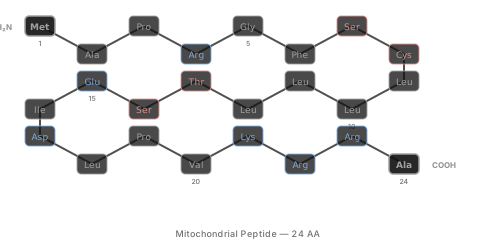
Humanin is a 21-amino-acid peptide that made history when it was discovered in 2001 by Japanese researchers led by Nishimoto et al. — it was the first peptide ever identified that is encoded within mitochondrial DNA rather than the cell's nuclear DNA. This was a landmark discovery because it upended a longstanding assumption: that mitochondria (the cell's power generators) only produced components of the respiratory chain, not signaling molecules that travel outside the mitochondria to communicate with other cells.
Humanin's levels naturally decline with age in both humans and model organisms. It circulates in the bloodstream and has been detected in multiple tissues including the brain, liver, and testes. Investigacióners have studied it in the context of Alzheimer's disease (where it was originally discovered), insulin signaling, cardiovascular stress responses, and general cellular stress defense. Its cousin MOTS-c, also in this library, was discovered by the same research lineage and further expanded understanding of mitochondrial-derived peptides.
⚡
Por qué interesa a los investigadores
Humanin changed how biologists think about mitochondria — it proved these organelles aren't just energy factories, they're also signaling centers that communicate with the rest of the body.
- As the founding member of the mitochondrial-derived peptide (MDP) class, Humanin opened an entirely new field of biology. Investigacióners now actively hunt for other MDPs, and the field has expanded significantly since its 2001 discovery.
- Its documented decline with age in circulation — and the observation that centenarians appear to have higher circulating levels — makes it a compelling biomarker candidate for aging research.
- Studies in animal models have examined Humanin's effects on neuronal survival under amyloid-beta stress (relevant to Alzheimer's research), insulin receptor signaling, and protection of cells against apoptosis (programmed cell death) triggered by various stressors.
- A synthetic analog called Humanin-G (HNG), with a single amino acid substitution (Gly for Ser at position 14), has been developed that researchers report is substantially more potent than native Humanin in cellular assays — making it useful for studying dose-response relationships.
⚙️
How It Works
Humanin acts through multiple receptor pathways. It binds to a trimeric receptor complex on cell surfaces (composed of CNTFR, WSX-1, and gp130 subunits) to activate JAK/STAT signaling — a pathway involved in cell survival and anti-apoptotic responses. It also interacts with IGFBP-3 (insulin-like growth factor binding protein 3), modulating insulin-like growth factor signaling. In neurological research contexts, Humanin has been observed to inhibit the toxicity of amyloid-beta peptides and APPS-mutated proteins that are associated with neurodegeneration. The peptide circulates in blood and can cross the blood-brain barrier, allowing it to act as a systemic signal that influences brain cell survival.
Think of it like this 🧠
Your mitochondria are like the power plants of the city (your body). Scientists used to think power plants just made electricity — they didn't send messages. Then Humanin was discovered, and it turned out the power plant was also sending distress signals and survival codes to the rest of the city when things got stressful. Humanin is like the power plant's emergency broadcast — it travels through the bloodstream telling other cells "we're under stress, here's how to survive it." And researchers found that as the city ages, those broadcasts get quieter.
📐
Contexto de Protocolo de Investigación
Investigación Renuncia de responsabilidad: Lo siguiente refleja investigación clínica y preclínica publicada y no es consejo médico. Consulta a un profesional de la salud licenciado antes de tomar decisiones de salud.
Humanin research is primarily preclinical, with well-characterized rodent and in vitro protocols. Human observational data exists (circulating humanin correlates with age and metabolic health), and Cohen Lab published the first documented dosing protocols for analogues.
Dosing Ranges from Published Investigación
Rodent Neuroprotection
Ikonen et al. (2003, PNAS) and Harada et al. (2004) administered ICV (intracerebroventicular) humanin at 1–100 µg in Alzheimer's mouse models. SC administration of HNG (Humanin-G, a potent analog) at 4 mg/kg has been used in metabolic and neuroprotection rodent studies (Cohen P. group, 2013, Aging Cell).
Metabolic Investigación
Muzumdar et al. (2009, FASEB J) administered HNG 4 mg/kg SC daily in mice for 4 weeks, documenting insulin sensitivity improvements. This remains one of the most cited dosing protocols in the humanin research literature.
Routes, Duration & Timing
SC / ICVSC used for systemic metabolic studies. ICV used for direct CNS neuroprotection studies in rodent models. No published human clinical trial data exists as of 2026.
TimelineInsulin sensitization measured at 4 weeks in metabolic studies. Neuroprotection endpoints in Alzheimer's models assessed at 4–8 weeks post-injection.
StorageLyophilized at −20°C. Reconstitute in sterile saline. The HNG analog is more stable than native humanin due to glycine substitution at position 14.
Referencias Clave: Muzumdar RH et al. (2009). Humanin HNG metabolic effects. FASEB J. · Ikonen M et al. (2003). Humanin Alzheimer's model neuroprotection. PNAS. · Cohen P (2014). Humanin review. Nat Rev Drug Discov.
✨
Datos Interesantes
🧬
Humanin was discovered by screening a human cDNA library derived from the surviving neurons of an Alzheimer's patient — the researchers were literally looking for what was keeping those neurons alive when everything else was dying. The answer turned out to be a peptide hiding inside mitochondrial DNA that no one had looked for there before.
👴
In a study examining blood samples from centenarians (people aged 100+) and their offspring, Humanin levels were found to be significantly higher than in age-matched controls. This correlation between circulating Humanin and exceptional longevity is one of the most-cited findings in the MDP research literature.
🔗
Humanin and MOTS-c — both in this research library — were discovered by overlapping research groups and are considered the founding members of the mitochondrial-derived peptide (MDP) family. Scientists now believe there may be dozens more MDPs yet to be identified in the mitochondrial genome.
📋
Documentación COA y de Lotes
Every batch of Humanin with full Certificate of Analysis documentation.
📄
HPLC Certificate
Documentation pending batch assignment
🔬
Mass Spec Analysis
Documentation pending batch assignment
✅
Purity Report
Documentation pending batch assignment
🧪
Sterility Test
Documentation pending batch assignment
Learn about our COA verification process →