🔬
What is it?
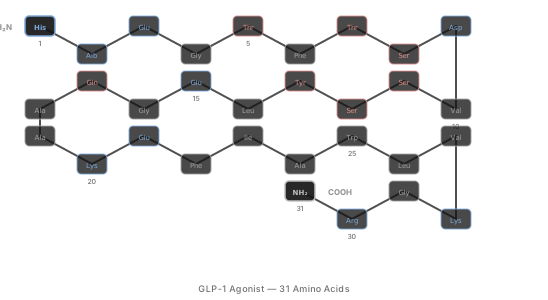
Semaglutide is a synthetic analog of GLP-1 (glucagon-like peptide-1), a hormone naturally produced by intestinal L-cells in response to food. Developed by Novo Nordisk, Semaglutide was engineered to have a much longer half-life than natural GLP-1 (which lasts only minutes in the body) — achieved through fatty acid conjugation that allows it to bind to albumin in the bloodstream, extending its activity to approximately one week per dose.
It has received FDA approval under multiple brand names for different conditions and administration routes: Ozempic (injectable, metabolic), Wegovy (injectable, weight management), and Rybelsus (oral, metabolic) — making Semaglutide the first oral GLP-1 receptor agonist ever approved.
The sheer volume of published research on Semaglutide is remarkable. It has been studied not just in metabolic contexts but also in cardiovascular outcome trials (SUSTAIN, SOUL), Alzheimer's research (EVOKE), alcohol use disorder research, and kidney disease progression research — making it one of the most multidimensionally investigated peptides in modern pharmacology.
⚡
Por qué interesa a los investigadores
Semaglutide's research footprint extends well beyond metabolism — it has become a scientific lens for examining how GLP-1 receptor activation affects tissues across the entire body.
- The SUSTAIN and SELECT cardiovascular trials demonstrated cardiovascular risk reduction effects, opening an entirely new dimension of GLP-1 receptor research beyond metabolic applications.
- EVOKE and related trials are examining Semaglutide in neurodegenerative disease contexts — researchers are investigating whether GLP-1 receptor activation in the brain has neuroprotective properties relevant to Alzheimer's disease progression.
- Semaglutide's oral bioavailability (Rybelsus) was a major pharmaceutical achievement — overcoming peptide degradation in the gut required development of an absorption enhancer (sodium N-(8-[2-hydroxybenzoyl] amino) caprylate) that took decades to perfect.
⚙️
How It Works
Semaglutide binds to GLP-1 receptors in the pancreas (stimulating glucose-dependent insulin release and suppressing glucagon), the brain (primarily hypothalamus, producing satiety signals), the gut (slowing gastric emptying), and cardiovascular tissue. The fatty acid side chain allows it to bind albumin, dramatically extending its half-life from minutes (native GLP-1) to approximately 7 days — which is why a once-weekly injection is sufficient for sustained receptor activation.
Think of it like this 🧠
Natural GLP-1 is like a text message that disappears in seconds — your gut sends it, your pancreas reads it, done. Semaglutide is like a sticky note that attaches to a courier (albumin) who walks slowly through your bloodstream all week, delivering the same message over and over. The pancreas and brain keep getting reminded to respond, long after the meal is over.
📐
Contexto de Protocolo de Investigación
Investigación Renuncia de responsabilidad: Lo siguiente refleja investigación clínica y preclínica publicada y no es consejo médico. Consulta a un profesional de la salud licenciado antes de tomar decisiones de salud.
Semaglutide is one of the most extensively studied GLP-1 receptor agonists with multiple phase III trial programs (SUSTAIN for T2DM, STEP for obesity, FLOW for kidney disease, SELECT for cardiovascular) providing among the largest clinical datasets of any injectable peptide.
Dosing Ranges from Published Investigación
Tipo 2 Diabetes (SC)
SUSTAIN trials (Aroda VR et al., 2017, Lancet Diabetes Endocrinol) established 0.5 mg and 1 mg SC once weekly as therapeutic doses with dose escalation over 4 weeks. SUSTAIN-6 (Marso SP et al., 2016, NEJM) documented 26% reduction in MACE at 1 mg/week over 104 weeks.
Obesity (SC)
STEP-1 (Wilding JPH et al., 2021, NEJM) used 2.4 mg SC once weekly (Ozempic/Wegovy dose) for 68 weeks — 16-week dose escalation to 2.4 mg target dose. Mean weight loss of 14.9% of body weight observed. HbA1c and cardiovascular risk factors as secondary endpoints.
Oral (Rybelsus)
PIONEER trials studied oral semaglutide 7–14 mg/day. PIONEER-8 (Zinman B et al., 2019, NEJM) used 14 mg daily oral for 52 weeks, taken 30+ minutes before first meal. Oral bioavailability ~1% requires higher absolute doses than SC.
Routes, Duration & Timing
SC — WeeklyOnce-weekly SC injection on a consistent day. No requirement for fasting or meal timing with SC formulation. Half-life ~1 week enables once-weekly dosing.
Oral — DailyOnce daily, 30 minutes before first meal of the day with ≤4 oz water. Absorption requires fasted state. Food significantly reduces oral bioavailability.
StoragePrefilled pen: 2–8°C before use; room temperature after first use (up to 28 days). Oral tablets: room temperature. No reconstitution.
Referencias Clave: Wilding JPH et al. (2021). STEP-1 semaglutide obesity. NEJM. · Marso SP et al. (2016). SUSTAIN-6 cardiovascular outcomes. NEJM. · Zinman B et al. (2019). PIONEER-8 oral semaglutide. NEJM.
✨
Datos Interesantes
🌍
Semaglutide is now one of the top-selling pharmaceutical compounds globally — Novo Nordisk's market cap exceeded Denmark's entire GDP in 2024, largely driven by Semaglutide demand across its multiple approved indications.
🧠
The EVOKE trial (Semaglutide in early Alzheimer's disease) is one of the largest investments ever made in testing a metabolic drug for a neurological condition — representing a fundamental expansion of GLP-1 receptor research into the CNS.
💊
Rybelsus was the first oral GLP-1 receptor agonist ever to achieve FDA approval — the science required to make a peptide survive the acidic stomach environment and absorb across the gut wall was more than 20 years in development.
📋
Documentación COA y de Lotes
Every batch of Semaglutide with full Certificate of Analysis documentation.
📄
HPLC Certificate
Documentation pending batch assignment
🔬
Mass Spec Analysis
Documentation pending batch assignment
✅
Purity Report
Documentation pending batch assignment
🧪
Sterility Test
Documentation pending batch assignment
Learn about our COA verification process →