🔬
What is it?
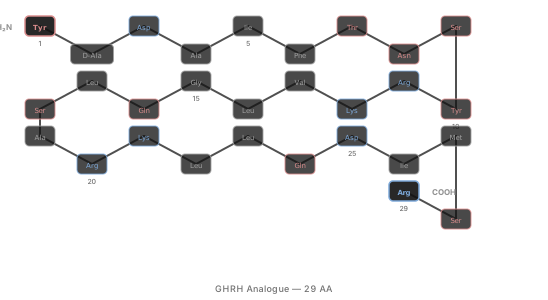
CJC-1295 is a synthetic 30-amino-acid peptide analog of Growth Hormone Releasing Hormone (GHRH), the hypothalamic signal that tells the pituitary gland to release growth hormone. But the really interesting part isn't the GHRH mimicry — it's the "DAC" modification. DAC stands for Drug Affinity Complex, a technology that covalently links the peptide to albumin, the most abundant protein in your blood.
Natural GHRH has a half-life of just a few minutes before enzymes degrade it. With the DAC modification, CJC-1295 binds to circulating albumin and achieves a half-life measured in days rather than minutes. This dramatically changes the pharmacokinetic profile from a short-pulse signal to a sustained, prolonged stimulation of GH release.
Researchers became interested in CJC-1295 as a tool for studying the growth hormone axis — the hypothalamus-pituitary-liver-muscle signaling chain — under conditions of sustained GHRH-like stimulation. Its ability to elevate both GH and IGF-1 levels in animal models over extended periods made it a distinctive tool for body composition, bone density, and muscle mass research.
📡 Weekly peptide research updates — regulatory updates, new compound profiles, COA alerts.
⚠️ FDA PCAC: -- days left
No spam. Unsubscribe anytime. 7 peptides under review — see what's at stake →
⚡
Why Researchers Care
- CJC-1295 DAC achieves something that natural GHRH cannot: sustained stimulation of growth hormone release over days from a single administration, giving researchers a tool to study what chronic GHRH signaling does to downstream systems.
- Published research has documented dose-dependent increases in plasma GH and IGF-1 levels in animal models, with the IGF-1 elevation being of particular interest for research into bone density, lean mass, and recovery processes.
- The albumin-binding mechanism (DAC) is itself a research topic — it demonstrates a general strategy for extending peptide half-life that has applications across many areas of pharmaceutical research.
- CJC-1295 is often studied in combination with GHRPs (Growth Hormone Releasing Peptides) like Ipamorelin, because GHRH and GHRP signaling are synergistic — together they produce more GH release than either alone.
- The compound has been used to study pituitary function, age-related decline in GH secretion, and the downstream metabolic effects of sustained IGF-1 elevation.
⚙️
How It Works
CJC-1295 binds to GHRH receptors on somatotroph cells in the anterior pituitary gland — the cells responsible for producing and releasing growth hormone. This binding activates a G-protein signaling cascade that increases intracellular cAMP, which triggers the synthesis and release of stored growth hormone into circulation.
Simultaneously, GH travels to the liver and other tissues where it stimulates IGF-1 (Insulin-like Growth Factor 1) production. IGF-1 is the primary downstream mediator of most of growth hormone's anabolic and repair effects. The DAC modification simply keeps the peptide circulating and active much longer than unmodified GHRH would allow.
Think of it like this 🧠
Think of the pituitary gland as a factory with a release valve for growth hormone. Normally, the hypothalamus sends short burst signals (GHRH) that open the valve briefly, release some GH, then the signal degrades in minutes. CJC-1295 with DAC is like replacing that short radio signal with a continuous broadcast — the valve stays partially open for days instead of minutes. The factory keeps producing and releasing GH at a sustained rate, and downstream factories (liver → IGF-1) run at elevated capacity throughout.
📐
Clinical Protocol Context
Research Disclaimer: The following reflects published clinical and preclinical research and is not medical advice. Consult a licensed healthcare provider before making any health decisions.
CJC-1295 was developed by ConjuChem and has been studied in published human clinical trials, making it one of the better-characterized long-acting GHRH analogs with documented dosing data from human subjects.
Dosing Ranges from Published Research
Phase I/II — Human
Ionescu et al. (2004, J Clin Endocrinol Metab) conducted a landmark dose-escalation study in healthy adults, administering CJC-1295 SC at 30–120 µg/kg. Dose-dependent increases in GH and IGF-1 were observed, with IGF-1 elevations sustained for 7–14 days after a single injection. The 60 µg/kg dose was identified as producing near-maximal GH/IGF-1 response.
Without DAC (mod-GRF 1-29)
The non-DAC form (mod-GRF 1-29) has a shorter half-life (~30 min) and requires more frequent administration. Studies have used 100–300 µg per injection for acute GH pulse studies, typically combined with a GHRP like ipamorelin for synergistic effect.
Administration Routes Studied
Subcutaneous
Primary route in human clinical trials. Abdominal SC injection produced measurable GH and IGF-1 responses within hours. The DAC form's long half-life makes SC the practical route for research protocols (Ionescu et al., 2004).
Intravenous
Used in pharmacokinetic characterization studies. IV administration showed faster initial GH response compared to SC. Albumin binding still occurred with IV administration.
Study Durations & Observed Timelines
Days 1–3
Peak GH response occurred within 2 hours of injection. IGF-1 elevation was measurable at 24 hours and continued rising through days 2–3 in the Ionescu et al. study.
Days 7–14
IGF-1 remained significantly elevated above baseline for 7–14 days after a single injection in human subjects (Ionescu et al., 2004). This duration of IGF-1 elevation from a single dose is the defining characteristic of the DAC mechanism.
6 Months+
Long-term repeat dosing studies in animal models ran 12–26 weeks without evidence of pituitary downregulation or tachyphylaxis, documenting sustained GH-secretory responsiveness (Walker et al., 2003, J Endocrinol).
Reconstitution & Storage Context
CJC-1295 (DAC form) is typically reconstituted from lyophilized powder using bacteriostatic water. Due to the long half-life, reconstituted CJC-1295 DAC has relatively forgiving storage requirements compared to shorter-acting peptides. Standard research protocols specify refrigeration (4°C) for reconstituted solution and −20°C for lyophilized storage. The non-DAC (mod-GRF 1-29) form has similar storage requirements but is administered more frequently due to shorter activity.
Frequency & Timing
The DAC form's ~6–8 day half-life in humans means once-weekly administration is used in many research protocols. The Ionescu et al. phase I study used single injections with 1–4 week intervals to assess duration of effect. Non-DAC (mod-GRF 1-29) protocols, when combined with a GHRP like ipamorelin, typically use 1–3 times daily at the same time as the GHRP for synergistic GH pulse generation.
Key References: Ionescu M & Frohman LA (2006). Pulsatile growth hormone secretion and CJC-1295 in humans. J Clin Endocrinol Metab. · Walker RF et al. (2003). Long-acting GHRH analogue. J Endocrinol. · Alba M et al. (2006). CJC-1295 safety and pharmacokinetics. J Clin Endocrinol Metab.
✨
Fun Facts
🧬
The albumin-binding strategy (DAC) is a clever piece of chemistry: the modification includes a maleimide group that reacts with a cysteine residue on serum albumin. This means CJC-1295 is essentially inert as a separate molecule until it encounters albumin in the bloodstream, at which point it chemically bonds and becomes a slow-release form.
📊
CJC-1295's documented half-life in animal models is approximately 6–8 days — compared to 7 minutes for natural GHRH. That's roughly 1,500x longer circulating activity from a single modification.
🔬
CJC-1295 is often combined with Ipamorelin in research protocols studying the GH axis. These two compounds target different receptors but converge on the same somatotroph cells to produce synergistic GH release.
<\!-- COA & Batch Documentation -->
📋
COA & Batch Documentation
Every batch of CJC-1295 with full Certificate of Analysis documentation. Third-party HPLC verification, mass spectrometry confirmation, and sterility testing results are included with each batch.
📄
HPLC Certificate
Documentation pending batch assignment
🔬
Mass Spec Analysis
Documentation pending batch assignment
✅
Purity Report
Documentation pending batch assignment
🧪
Sterility Test
Documentation pending batch assignment
Learn about our COA verification process →