🔬
What is it?
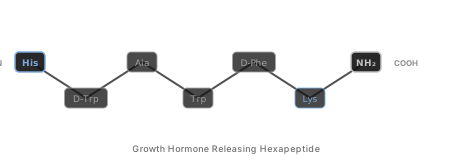
GHRP-6 (Growth Hormone Releasing Peptide-6) is a synthetic hexapeptide (6 amino acids) that was one of the first compounds developed to stimulate growth hormone release by a mechanism distinct from GHRH. Discovered in the 1980s by Cyril Bowers at Tulane University, GHRP-6 represented a major breakthrough in understanding GH secretion — it proved that there was a second, independent pathway for stimulating the pituitary to release GH, separate from the GHRH receptor pathway. This discovery ultimately led to the identification of ghrelin (the "hunger hormone") and the characterization of the ghrelin receptor (GHS-R1a) — a major contribution to endocrinology.
GHRP-6 is a "dirty" GHRP compared to more selective later compounds like Ipamorelin — meaning it produces strong GH release but also activates off-target pathways, causing notable cortisol elevation, prolactin elevation, and pronounced appetite stimulation. These properties actually make it useful as a research tool for studying the full spectrum of ghrelin receptor activation, including appetite regulation.
As the first widely studied GHRP, GHRP-6 remains a reference compound for the entire class.
📡 Weekly peptide research updates — regulatory updates, new compound profiles, COA alerts.
⚠️ FDA PCAC: -- days left
No spam. Unsubscribe anytime. 7 peptides under review — see what's at stake →
⚡
Why Researchers Care
- GHRP-6 was instrumental in the discovery of the ghrelin receptor system — one of the most significant findings in hormonal regulation research of the last 30 years. It's a piece of the history of endocrinology.
- It produces among the strongest acute GH pulses of any GHRP, making it a reference standard for comparing potency of newer GH secretagogues.
- Unlike selective GHRPs, GHRP-6's cortisol and appetite-stimulating effects have been studied in their own right — it's been used to examine how the ghrelin receptor intersects with stress hormone regulation and hunger signaling.
- GHRP-6 has been studied in cardiac contexts — some published research suggests ghrelin receptor activation may have cardioprotective effects in ischemia models, and GHRP-6 is one of the research tools used in that work.
- Its 6-amino-acid simplicity (hexapeptide) makes it an ideal reference compound for structure-activity relationship studies examining which amino acid positions in GHRPs determine receptor selectivity.
⚙️
How It Works
GHRP-6 binds to the ghrelin receptor (GHS-R1a) on somatotroph cells in the anterior pituitary, triggering a signaling cascade that results in GH exocytosis. Unlike GHRH-based peptides (like CJC-1295 or Sermorelin), GHRP-6 works through a completely separate receptor and signaling pathway — but the end result of GH release is the same, and the two pathways are synergistic when combined.
GHRP-6 also activates GHS-R1a in the hypothalamus, where it amplifies the natural GHRH signal and suppresses somatostatin (the hormone that inhibits GH release), creating a dual-action amplification of GH output. The appetite stimulation comes from GHS-R1a activation in the hypothalamic arcuate nucleus, where ghrelin receptor signaling drives hunger signals — GHRP-6 activates this pathway as a side effect of binding the same receptor.
Think of it like this 🧠
Think of the pituitary GH release system as a locked room with two different keys. GHRH (mimicked by CJC-1295 and Sermorelin) uses the first key (GHRH receptor). GHRP-6 uses the second key (ghrelin receptor). Both open the door and release GH. Use both keys simultaneously and the door opens much wider. GHRP-6's extra "side effects" are because the ghrelin receptor is also found in other rooms (hypothalamus, heart) — and GHRP-6 doesn't have the precision to open only the pituitary door.
📐
Clinical Protocol Context
Research Disclaimer: The following reflects published clinical and preclinical research and is not medical advice. Consult a licensed healthcare provider before making any health decisions.
GHRP-6 was extensively studied in human subjects in the 1990s as the original GHRP — its clinical pharmacology profile is well-established in the published literature.
Dosing Ranges from Published Research
Human Clinical
Bowers et al. (1991, J Clin Endocrinol Metab) conducted early human dose-escalation studies at 0.3–3 µg/kg IV. At 1 µg/kg IV, GHRP-6 produced GH pulses equivalent to maximal GHRH stimulation. Chaterjee et al. (1997) published 1 µg/kg SC protocols with measurable GH response within 20 minutes.
Combined with GHRH
Studies combining GHRH and GHRP-6 found synergistic GH release — co-administration of 1 µg/kg of each produced GH responses 5–10x greater than either alone (Jaffe et al., 1993, J Clin Endocrinol Metab). This synergism established the mechanistic rationale for GHRH/GHRP combination protocols.
Routes, Duration & Timing
IV / SCIV used in pharmacokinetic and acute GH studies. SC used for research protocols. GH response peaks at 15–60 min, returns to baseline within 2–3 hours.
Appetite EffectsPronounced hunger increase observed within 30 min of administration in human subjects — a consistent finding across multiple studies that researchers use to study the ghrelin/appetite axis.
StorageLyophilized at −20°C; reconstitute in bacteriostatic water; store at 4°C after reconstitution.
Key References: Bowers CY et al. (1991). GHRP-6 in humans. J Clin Endocrinol Metab. · Jaffe CA et al. (1993). GHRH + GHRP-6 synergism. J Clin Endocrinol Metab. · Bowers CY (1998). GHRP history review. J Pediatr Endocrinol Metab.
✨
Fun Facts
🏆
GHRP-6 is the compound that indirectly led to the 1999 discovery of ghrelin — the hunger hormone. Researchers knew GHRP-6 bound a receptor in the pituitary and hypothalamus, and they went looking for the natural hormone that used that receptor. What they found was ghrelin. So a synthetic peptide preceded and enabled the discovery of its own natural analog.
🧪
Cyril Bowers, who developed GHRP-6, spent decades systematically modifying the enkephalin peptide structure (yes, related to endorphins) looking for molecules that stimulate GH. The GHRP class emerged from that painstaking chemical modification work — an example of how random-seeming peptide design sometimes stumbles into something important.
💉
GHRP-6 has one of the most pronounced appetite-stimulating effects of any research peptide — subjects in research trials consistently report intense hunger after administration. This made it less useful clinically but more useful for studying the ghrelin receptor's role in appetite regulation specifically.
📋
COA & Batch Documentation
Every batch of GHRP-6 with full Certificate of Analysis documentation. Third-party HPLC verification, mass spectrometry confirmation, and sterility testing results are included with each batch.
📄
HPLC Certificate
Documentation pending batch assignment
🔬
Mass Spec Analysis
Documentation pending batch assignment
✅
Purity Report
Documentation pending batch assignment
🧪
Sterility Test
Documentation pending batch assignment
Learn about our COA verification process →