🔬
What is it?
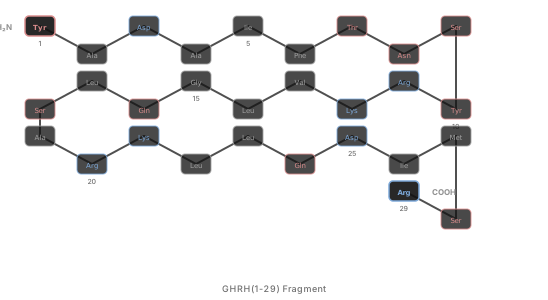
Sermorelin is a synthetic 29-amino-acid analog corresponding to the first 29 amino acids of natural Growth Hormone Releasing Hormone (GHRH). The natural GHRH molecule is 44 amino acids long, but researchers discovered that the first 29 amino acids contain the complete biological activity for GHRH receptor binding and GH release — the remaining 15 amino acids at the C-terminus are needed for stability but not receptor activation.
Sermorelin (GHRH 1-29) was developed and studied as a pharmaceutical agent, receiving FDA approval as Geref (sermorelin acetate) for the diagnostic evaluation of pituitary function and for the treatment of GH deficiency in children. This made it the first clinically approved GHRH analog. While Geref was later withdrawn from the US market for commercial reasons (not safety concerns), Sermorelin remains one of the most extensively studied GHRH analogs in both clinical and research contexts.
Its long track record, safety data, and well-characterized mechanism make it a reference compound for the broader class of GHRH analogs.
📡 Weekly peptide research updates — regulatory updates, new compound profiles, COA alerts.
⚠️ FDA PCAC: -- days left
No spam. Unsubscribe anytime. 7 peptides under review — see what's at stake →
⚡
Why Researchers Care
- Sermorelin has more clinical safety and efficacy data than almost any other peptide in the GH secretagogue category, giving researchers a well-characterized reference compound.
- Unlike direct GH administration, Sermorelin stimulates the pituitary to produce its own GH in a pulsatile, regulated fashion — maintaining the natural feedback loops that prevent excessive GH levels.
- Its use in pituitary function testing established a clinical precedent for using GHRH stimulation as a diagnostic and research tool for assessing pituitary GH secretory capacity.
- Research has examined Sermorelin in the context of age-related GH decline — as adults age, pituitary GH output naturally decreases, and GHRH analogs like Sermorelin have been studied as a way to examine whether declining GH is due to pituitary failure or hypothalamic GHRH deficiency.
- Its shorter active fragment structure (vs. full 44-aa GHRH) provides a useful research comparison to understand which parts of the GHRH molecule are required for different aspects of receptor interaction.
⚙️
How It Works
Sermorelin binds directly to GHRH receptors (GHRHR) on somatotroph cells in the anterior pituitary. This activates a Gs protein-coupled signaling cascade, increasing intracellular cyclic AMP (cAMP) and ultimately calcium signaling, which triggers the exocytosis of stored growth hormone vesicles. The GH released then travels to the liver and peripheral tissues to stimulate IGF-1 production.
Crucially, the body's natural negative feedback mechanisms remain intact — as GH rises, somatostatin (the GH-inhibiting hormone) is also released, which prevents runaway GH overproduction. This self-regulating feature is one reason Sermorelin is considered a relatively clean research tool for GH axis studies.
Think of it like this 🧠
The hypothalamus and pituitary are like a two-part walkie-talkie system: the hypothalamus sends GHRH (the "release GH now" message), and the pituitary responds by releasing GH. Sermorelin is a copy of that radio message. Injecting Sermorelin is like transmitting the correct radio signal directly to the pituitary's receiver — the pituitary hears the message and responds normally, releasing GH in its natural pattern, with all the normal feedback controls still operating. Direct GH injection bypasses this entirely — it's like dropping GH canisters from a helicopter and hoping it's the right amount.
📐
Clinical Protocol Context
Research Disclaimer: The following reflects published clinical and preclinical research and is not medical advice. Consult a licensed healthcare provider before making any health decisions.
Sermorelin has an unusually deep clinical research record for a peptide, including FDA-approved diagnostic use and multiple published human trials dating back to the 1970s and 1980s. The following summarizes parameters as studied and administered in the published literature.
Dosing Ranges from Published Research
Diagnostic Testing
The FDA-approved Geref diagnostic test administered 1 µg/kg intravenously as a bolus to assess GH secretory capacity. This single-dose diagnostic protocol was the gold standard for pituitary GH reserve evaluation (Walker et al., 1990, J Clin Endocrinol Metab).
Pediatric GHD Treatment
Clinical trials in children with GH deficiency studied subcutaneous Sermorelin at 0.03 mg/kg/day. Studies ran 12–24 months with growth velocity and IGF-1 normalization as endpoints (Thorner et al., 1996, NEJM; Lanes, 1992, J Pediatr).
Adult Anti-Aging Research
An RCT by Merriam et al. (2001, J Clin Endocrinol Metab) administered Sermorelin 0.5 mg/day SC at bedtime to healthy elderly subjects over 26 weeks. GH pulse amplitude increased and IGF-1 rose toward youthful ranges. Bedtime administration was chosen to align with endogenous GH pulsatility.
Administration Routes Studied
Intravenous
Used exclusively in the diagnostic bolus protocol. IV administration produced peak GH responses within 30–60 minutes, used to classify pituitary GH reserve (Walker et al., 1990).
Subcutaneous
Standard route for therapeutic and research protocols. Abdominal SC administration produced measurable GH pulses within 20–45 minutes. Subcutaneous bioavailability is sufficient for GH axis stimulation at therapeutic doses.
Study Durations & Observed Timelines
Weeks 1–4
GH pulse amplitude increases detected within the first weeks of daily administration. IGF-1 elevation measurable at 4-week blood draws in adult studies (Merriam et al., 2001).
Months 3–6
Body composition changes (lean mass gain, fat mass reduction) observed at 3–6 month endpoints in the Merriam et al. adult study. Sleep quality and energy endpoints also assessed in this window.
Months 12–24
Pediatric GHD trials ran 12–24 months. Growth velocity improvements observed beginning at month 3–6 and maintained through trial endpoints (Thorner et al., 1996, NEJM).
Reconstitution & Storage Context
The Geref formulation was supplied as lyophilized sermorelin acetate with diluent. Research protocols reconstitute in bacteriostatic water for injection. Published stability data supports refrigeration (2–8°C) of reconstituted solution. Lyophilized form documented stable at −20°C. Half-life in plasma is approximately 10–20 minutes (rapid enzymatic degradation), which is why bedtime injection was used in research to align with the nocturnal GH pulse.
Frequency & Timing
Daily subcutaneous administration at bedtime was the protocol used in the Merriam et al. adult study (Merriam et al., 2001). This timing rationale — injecting at bedtime to mimic the naturally highest-amplitude nocturnal GH pulse — was explicitly stated in the study methodology. Pediatric therapeutic protocols also used daily bedtime administration to preserve pulsatility while maximizing GH secretion (Thorner et al., 1996).
Key References: Thorner MO et al. (1996). Sermorelin therapy in children with GH deficiency. NEJM. · Merriam GR et al. (2001). Sermorelin in healthy elderly subjects. J Clin Endocrinol Metab. · Walker JL et al. (1990). GHRH stimulation test — diagnostic criteria. J Clin Endocrinol Metab. · Lanes R (1992). Sermorelin vs. GH in GH deficiency. J Pediatr.
✨
Fun Facts
🏛️
Sermorelin was the first synthetic GHRH analog to receive FDA approval — a milestone that established the clinical validity of pituitary stimulation as a therapeutic and diagnostic approach. That happened in the 1980s, making it one of the older members of the modern synthetic peptide era.
🔬
The discovery that GHRH(1-29) retains full activity was itself a significant research finding — it showed that the first 29 of 44 amino acids carry all the biological information needed for receptor activation, and the C-terminal portion serves mainly a structural and stability role. This kind of structure-function research is fundamental to modern peptide drug design.
💉
Sermorelin was withdrawn from the US market as Geref in 2008 — not due to safety issues, but because the manufacturer decided to discontinue production of the injectable pediatric formulation. It remains in active research use and continues to be studied in anti-aging and endocrinology research contexts.
<\!-- COA & Batch Documentation -->
📋
COA & Batch Documentation
Every batch of Sermorelin with full Certificate of Analysis documentation. Third-party HPLC verification, mass spectrometry confirmation, and sterility testing results are included with each batch.
📄
HPLC Certificate
Documentation pending batch assignment
🔬
Mass Spec Analysis
Documentation pending batch assignment
✅
Purity Report
Documentation pending batch assignment
🧪
Sterility Test
Documentation pending batch assignment
Learn about our COA verification process →