🔬
What is it?
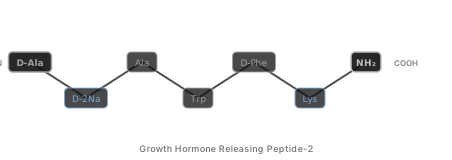
GHRP-2 (Growth Hormone Releasing Peptide-2) is a second-generation synthetic hexapeptide GH secretagogue that builds on the discoveries made with GHRP-6. Developed in the late 1980s and studied through the 1990s, GHRP-2 was engineered to achieve stronger GH-releasing potency than GHRP-6 through strategic D-amino acid substitutions that improve receptor binding affinity and resistance to enzymatic degradation.
In Japan, GHRP-2 (as Pralmorelin, brand name GRF) received pharmaceutical approval as a diagnostic agent for assessing growth hormone deficiency in adults — making it one of the few GHRPs with actual pharmaceutical regulatory approval history. This clinical background gives GHRP-2 an unusually well-characterized safety and pharmacokinetic profile compared to most research peptides.
Like GHRP-6, GHRP-2 activates the ghrelin receptor and produces cortisol and prolactin elevations as off-target effects, though the degree of appetite stimulation is generally reported to be less pronounced than with GHRP-6. Its strong GH-stimulating potency and clinical approval history make it a reference compound for GH secretagogue research.
⚡
Por qué interesa a los investigadores
- GHRP-2 has pharmaceutical regulatory history in Japan as a diagnostic agent for GH deficiency, providing published human pharmacokinetic and safety data that most research peptides never accumulate.
- Its GH-stimulating potency is among the highest of the GHRP class — documented in multiple studies to produce larger acute GH pulses than GHRP-6 at equivalent doses in animal models.
- The D-amino acid modifications in GHRP-2 make it more resistant to enzymatic degradation than GHRP-6, extending its biological half-life and making it useful for pharmacokinetic comparison studies within the GHRP class.
- Investigación has used GHRP-2 to study the relationship between GH pulses and downstream IGF-1 production, as well as the dose-response relationship for GH secretion through the ghrelin receptor pathway.
⚙️
How It Works
GHRP-2 binds to GHS-R1a (the ghrelin receptor) with higher affinity than GHRP-6, triggering stronger GH secretion from pituitary somatotrophs. The D-amino acid modifications at specific positions in the hexapeptide chain — particularly D-Ala at position 2 — confer resistance to aminopeptidase enzymes that would rapidly degrade a standard L-amino acid peptide, extending the peptide's duration of action.
The pharmacological result is a shorter, larger GH pulse compared to GHRP-6, reflecting the higher receptor binding affinity and enzyme resistance. Cortisol and prolactin elevations occur through the same ghrelin receptor activation in the hypothalamus and pituitary, though the cortisol elevation may be somewhat less pronounced than with GHRP-6 in some models — a difference researchers have studied to understand ghrelin receptor pharmacology in detail.
Think of it like this 🧠
If GHRP-6 is a key that opens the GH room but also rattles every other door on the floor, GHRP-2 is a slightly better-cut version of that same key — it opens the GH room faster and more reliably (higher potency), still rattles some of the same doors (cortisol, prolactin), but the key is made of harder metal so it stays sharp longer (enzyme resistance). The building layout (receptor biology) is identical — GHRP-2 is just a better-engineered version of the same key.
📐
Contexto de Protocolo de Investigación
Investigación Renuncia de responsabilidad: Lo siguiente refleja investigación clínica y preclínica publicada y no es consejo médico. Consulta a un profesional de la salud licenciado antes de tomar decisiones de salud.
GHRP-2 (Pralmorelin) received regulatory approval in Japan as a diagnostic test for GH deficiency, giving it a documented human clinical dosing profile from GH stimulation test research.
Dosing Ranges from Published Investigación
Diagnostic (Japan-approved)
Pralmorelin was studied and approved for IV administration at 2 µg/kg (100 µg max) as a single bolus for GH stimulation testing. Studies documented peak GH response at 30–60 minutes post-injection (Bowers et al., 1997, Endocrine).
Investigación Protocols
Multiple-dose human studies have used 1–2 µg/kg SC or IV. Hartman et al. (1996, J Clin Endocrinol Metab) used 1 µg/kg IV in multiple GH pulse studies. Preclinical rodent protocols have used 50–200 µg/kg/day SC.
Routes, Duration & Timing
IV / SCIV used for diagnostic testing; SC used in multi-dose research protocols. GH pulse rises within 15–45 min of injection, returns to baseline within 2–3 hours.
FrequencySingle-dose diagnostic protocol; multi-dose research used 1–3×/day SC in animal studies. Once- to twice-daily SC in human GH research protocols.
StorageLyophilized form stable at −20°C; reconstituted solution stored at 4°C. Reconstitute in bacteriostatic water.
Referencias Clave: Bowers CY et al. (1997). GHRP-2 pharmacology. Endocrine. · Hartman ML et al. (1996). GHRP-2 GH stimulation. J Clin Endocrinol Metab. · Arvat E et al. (1997). GHRP-2 vs GHRP-6. J Endocrinol Invest.
✨
Datos Interesantes
🇯🇵
Pralmorelin (GHRP-2) received pharmaceutical approval in Japan as a diagnostic tool for GH deficiency — a notable regulatory milestone for a GHRP. This required clinical trial data demonstrating its ability to reliably stimulate GH release as a pituitary function test.
⚗️
The D-amino acid (specifically D-Ala) modification in GHRP-2 is a classic peptide chemistry trick. Natural amino acids are "L" configuration. Switching a single amino acid to its "D" mirror image can dramatically increase a peptide's resistance to the proteolytic enzymes (proteases) that would otherwise degrade it in minutes.
📊
GHRP-2 and GHRP-6 are often compared side-by-side in research models specifically to understand how structural modifications to the same basic hexapeptide scaffold change receptor binding and downstream signaling — a classic approach to structure-activity relationship analysis.
📋
Documentación COA y de Lotes
Every batch of GHRP-2 with full Certificate of Analysis documentation. Third-party HPLC verification, mass spectrometry confirmation, and sterility testing results are included with each batch.
📄
HPLC Certificate
Documentation pending batch assignment
🔬
Mass Spec Analysis
Documentation pending batch assignment
✅
Purity Report
Documentation pending batch assignment
🧪
Sterility Test
Documentation pending batch assignment
Learn about our COA verification process →