🔬
What is it?
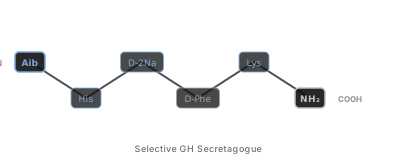
Ipamorelin is a synthetic five-amino-acid peptide (pentapeptide) that acts as a Growth Hormone Releasing Peptide (GHRP) — it stimulates the pituitary gland to release growth hormone by acting on ghrelin receptors (the GHS-R1a receptor). It was developed by Novo Nordisk in the 1990s as a research tool and later studied as a pharmaceutical candidate.
What made Ipamorelin scientifically interesting was what it didn't do as much as what it did. Earlier GHRPs like GHRP-6 and GHRP-2 also stimulate GH release but come with significant side effects in research models: they also elevate cortisol, prolactin, and cause pronounced appetite stimulation. Ipamorelin was engineered to be highly selective — it stimulates GH release with minimal off-target receptor activation, making it a cleaner research tool for studying GH secretion in isolation.
This selectivity has made Ipamorelin the preferred GHRP for many research models where the goal is to study GH and IGF-1 effects without confounding variables from cortisol or prolactin changes.
⚡
Por qué interesa a los investigadores
- Ipamorelin is the most selective GHRP in widespread use for research — its GH-releasing potency is comparable to GHRP-6, but without the cortisol and prolactin elevations that complicate interpretation of results.
- It produces natural-pattern GH pulses rather than sustained baseline elevation, which is important for research into how the body's pulsatile GH secretion rhythm affects downstream biology.
- Because it doesn't significantly elevate cortisol, researchers can study GH and IGF-1 effects in isolation without the muscle-catabolism confound that cortisol introduces.
- Ipamorelin is frequently combined with CJC-1295 in research protocols, because GHRH (mimicked by CJC-1295) and ghrelin receptor activation (mimicked by Ipamorelin) are synergistic pathways that together produce greater GH release than either alone.
- Published research in animal models has shown effects on body composition (lean mass, fat mass), bone density, and recovery parameters when GH/IGF-1 are elevated.
⚙️
How It Works
Ipamorelin binds to the ghrelin receptor (GHS-R1a), which is expressed on somatotroph cells in the anterior pituitary. This receptor was first identified as the receptor for ghrelin — the "hunger hormone" — but it turns out ghrelin receptor activation also potently stimulates GH release. Ipamorelin mimics this ghrelin-receptor activation specifically for the GH release effect, while being engineered to minimize the appetite-stimulating and cortisol-releasing effects that natural ghrelin and older GHRPs produce.
The result is a GH pulse that looks similar to a natural pituitary GH pulse — short, pronounced, and self-limiting — rather than a sustained elevation.
Think of it like this 🧠
Think of the pituitary as a drummer who releases GH in rhythmic beats. Natural pituitary signaling creates a specific beat pattern — big pulses during sleep, smaller pulses through the day. Ipamorelin is like a very precise drum stick that triggers exactly one clean beat on the GH drum without accidentally hitting the cortisol cymbal or the prolactin snare. Older GHRPs were like hitting all the drums at once.
📐
Contexto de Protocolo de Investigación
Investigación Renuncia de responsabilidad: Lo siguiente refleja investigación clínica y preclínica publicada y no es consejo médico. Consulta a un profesional de la salud licenciado antes de tomar decisiones de salud.
Ipamorelin was developed by Novo Nordisk and has been studied in phase I/II human trials for GI motility disorders in addition to GH research. Published pharmacokinetic and GH-response data from these trials provides concrete clinical reference points.
Dosing Ranges from Published Investigación
Phase I — Human
Raun et al. (1998, Eur J Endocrinol) conducted dose-escalation studies in healthy adult males, administering 1–100 µg/kg IV and SC. Peak GH responses were observed at doses ≥30 µg/kg. The 30 µg/kg SC dose produced GH pulses comparable in amplitude to physiological sleep-related pulses.
GI Motility Trial
Ipamorelin (NNC 26-0161) was studied in postoperative ileus studies at doses of 300–600 µg IV three times daily. A phase III trial (Poitras et al., 2009, J Gastrointest Surg) showed earlier time to first bowel movement versus placebo but did not reach primary endpoint.
Preclinical
Rodent studies have used 125–500 µg/kg/day SC. Bone density studies (Svensson et al., 2000, Growth Horm IGF Res) used 1 nmol/day SC in ovariectomized rats with significant increases in tibial bone density observed at 12 weeks.
Vías de Administración Estudiadas
Subcutánea
Standard route in GH research protocols. SC administration produced measurable GH pulses with a peak at approximately 15–45 minutes post-injection, returning to baseline within 2–3 hours (Raun et al., 1998).
Intravenous
Used in dose-escalation pharmacokinetic studies and in the postoperative ileus trials. IV bolus produced faster onset and higher peak GH than SC at equivalent doses.
Duraciones de Estudios y Cronogramas Observados
Acute (24h)
GH pulse measured within hours in pharmacokinetic studies. No tachyphylaxis to repeat dosing was observed in the Raun et al. multi-day dosing assessments — each injection produced a comparable GH response.
Weeks 4–12
Animal bone density studies ran 12 weeks with measurable BMD increases at study endpoint. Body composition changes (lean mass, fat mass) assessed at 12-week intervals in preclinical protocols.
Reconstitución y Almacenamiento
Ipamorelin in research settings is reconstituted from lyophilized powder using bacteriostatic water. The short half-life (approximately 2 hours in plasma) means solution stability requirements are less critical than compounds requiring longer exposures. Lyophilized stability documented at −20°C for extended storage. Reconstituted solution stability at 4°C is cited in standard research protocols as adequate for short-term use (days).
Frecuencia y Tiempo
GI motility clinical trials used three-times-daily IV administration (around meals). Investigación protocols for GH axis studies have generally used 1–3 SC injections per day. The nocturnal GH pulse timing rationale (used for Sermorelin) also applies — bedtime or overnight dosing aligns with peak somatotroph sensitivity to secretagogue stimulation. No published randomized comparison of dosing timing exists for ipamorelin specifically.
Referencias Clave: Raun K et al. (1998). Ipamorelin — selective GH secretagogue. Eur J Endocrinol. · Svensson J et al. (2000). Ipamorelin bone density in rodents. Growth Horm IGF Res. · Poitras P et al. (2009). Ipamorelin postoperative ileus trial. J Gastrointest Surg.
✨
Datos Interesantes
🎯
Ipamorelin's selectivity was a deliberate engineering achievement, not an accident. Investigacióners at Novo Nordisk systematically modified the GHRP-2 peptide structure to eliminate off-target receptor activation while preserving GH-releasing potency — a nice example of rational peptide drug design.
🔬
The ghrelin receptor that Ipamorelin activates was discovered after ipamorelin was already in development — scientists identified a receptor whose ligand turned out to be ghrelin. Ipamorelin was part of the research toolkit that helped characterize this receptor system.
📈
Investigación in animal models has shown Ipamorelin's GH-releasing effect is amplified roughly 3–5x when combined with a GHRH analog like CJC-1295 — demonstrating the synergistic interplay between the two GH-stimulating pathways.
<\!-- COA & Batch Documentation -->
📋
Documentación COA y de Lotes
Every batch of Ipamorelin with full Certificate of Analysis documentation. Third-party HPLC verification, mass spectrometry confirmation, and sterility testing results are included with each batch.
📄
HPLC Certificate
Documentation pending batch assignment
🔬
Mass Spec Analysis
Documentation pending batch assignment
✅
Purity Report
Documentation pending batch assignment
🧪
Sterility Test
Documentation pending batch assignment
Learn about our COA verification process →