Immune Support
LL-37
A human antimicrobial peptide that fights pathogens directly while simultaneously signaling the immune system for backup.
Hover to pause rotation
A human antimicrobial peptide that fights pathogens directly while simultaneously signaling the immune system for backup.
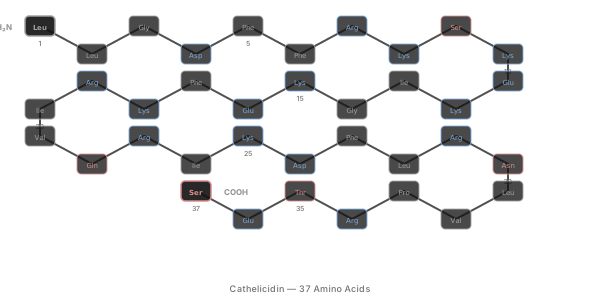
LL-37 is a naturally occurring antimicrobial peptide — one your own body already makes. It's part of the cathelicidin family of immune peptides, produced by immune cells like neutrophils and macrophages as well as by skin cells, lung cells, and gut cells. The name "LL-37" comes from its structure: it starts with two leucine (L) amino acids and is 37 amino acids long total. It's a frontline soldier in the innate immune system — the part of immunity you're born with, not the learned kind.
LL-37 has a fascinating dual role: it's both directly antimicrobial (it can punch holes in bacterial membranes) AND an immune signaling molecule that calls in other parts of the immune response. Investigacióners have been studying it across a remarkably wide range of contexts, from infection response to tissue healing to inflammatory conditions.
What sets LL-37 apart from many research peptides is that it isn't something foreign to the body — it's endogenous, meaning your own cells produce it as part of normal immune function. This makes it a compelling subject for research into how the innate immune system coordinates multi-layered defense responses.
Because it's produced locally at epithelial surfaces — skin, airways, gut lining — LL-37 is at the intersection of the body's physical barriers and its biochemical defense systems. That dual position has driven interest in everything from respiratory immunity to dermatological wound healing research.
LL-37's combination of direct antimicrobial action and immune signaling activity makes it one of the more versatile peptides in innate immunity research.
LL-37 disrupts microbial membranes through electrostatic attraction — bacteria have negatively charged membranes, and LL-37 carries a positive charge, so it's attracted to them. Once it binds, it disrupts the membrane integrity, often leading to bacterial cell death. It also binds to LPS (lipopolysaccharide), a toxin released by bacteria, and neutralizes it. Simultaneously, LL-37 interacts with surface receptors on immune cells, triggering chemokine-like signaling that recruits neutrophils and other immune cells to the site of infection — coordinating a broader immune response beyond its own direct action.
Imagine your immune system as a city with walls and alarm systems. LL-37 is like a patrol unit that does two jobs at once: it actively punches holes in enemy vehicles trying to breach the walls (antimicrobial), AND it radios back to headquarters to call in backup (immune signaling). Most defenders do one job. LL-37 does both.
Investigación Renuncia de responsabilidad: Lo siguiente refleja investigación clínica y preclínica publicada y no es consejo médico. Consulta a un profesional de la salud licenciado antes de tomar decisiones de salud.
LL-37 (hCAP-18 active peptide) has been studied in Phase I/II clinical trials for wound healing and anti-infective applications, with published human data from investigator-sponsored studies.
Referencias Clave: Lipsky BA et al. (2008). LL-37 topical for venous ulcers. Ann Intern Med. · Heilborn JD et al. (2003). LL-37 wound healing. J Invest Dermatol. · Koczulla R et al. (2003). LL-37 angiogenesis. J Clin Invest.
LL-37 is produced in sweat — yes, your sweat actually contains antimicrobial peptides. Investigacióners have studied sweat as part of skin defense research.
The cathelicidin family (which includes LL-37) exists in virtually all vertebrates — from fish to frogs to humans. Snakes have their own cathelicidins too.
Investigación has noted that vitamin D deficiency correlates with reduced LL-37 production — vitamin D actually regulates the gene that encodes LL-37 (the CAMP gene). This connection has made LL-37 relevant to micronutrient and immunity research.
Every batch of LL-37 with full Certificate of Analysis documentation. Third-party HPLC verification, mass spectrometry confirmation, and sterility testing results are included with each batch.