🔬
What is it?
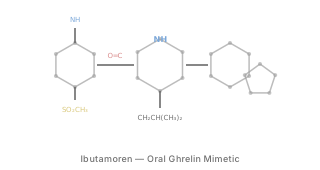
MK-677, also known as Ibutamoren, is genuinely unusual in this research library: it's not technically a peptide at all. While every other compound in the Growth Hormone Secretagogue category is a peptide (strings of amino acids), MK-677 is a small organic molecule — a non-peptide ghrelin receptor agonist developed by Merck. This distinction matters enormously for research applications. Peptide GH secretagogues like GHRP-6 and Ipamorelin are rapidly degraded in the stomach and must be administered by injection to be effective. MK-677 is orally active, meaning it survives digestion and reaches the bloodstream after oral administration — making it one of the only orally bioavailable GH secretagogues studied in humans.
Developed in the mid-1990s, MK-677 was extensively studied in clinical trials by Merck for GH deficiency, aging-related muscle loss (sarcopenia), and other conditions involving low IGF-1. Merck ultimately didn't advance it to regulatory approval, but the clinical data generated — including multiple published trials in elderly populations showing sustained IGF-1 elevation over months — makes it one of the most clinically characterized GH secretagogues in existence.
⚡
Por qué interesa a los investigadores
- MK-677's oral bioavailability makes it a fundamentally different research tool than injectable GHRPs — researchers can study the effects of sustained ghrelin receptor activation via oral dosing, which is the delivery route most relevant to any future therapeutic applications.
- Published clinical trials in elderly subjects have documented sustained elevations in GH and IGF-1 levels over 12+ months of oral dosing — making it one of the most long-term-characterized GH secretagogues in human research.
- Merck's clinical trials generated data on bone density, muscle mass, and body composition under sustained IGF-1 elevation in elderly populations — a uniquely valuable dataset that goes far beyond what most peptide research produces.
- MK-677 specifically activates ghrelin receptors in a sustained, non-pulsatile manner — creating a different GH secretion pattern than injectable GHRPs, making it useful for comparing pulsatile vs. sustained GH axis activation.
- Investigación has examined MK-677 in growth hormone deficiency, obesity, bone metabolism, and aging-related decline contexts, producing a diverse body of published literature.
⚙️
How It Works
MK-677 is a ghrelin mimetic — it binds to the ghrelin receptor (GHS-R1a) and activates the same signaling cascade as ghrelin itself, stimulating growth hormone release from pituitary somatotrophs. But because it's a small organic molecule rather than a peptide, it's designed to survive oral absorption: it's resistant to stomach acid degradation, absorbs through the intestinal wall, and reaches systemic circulation intact. Once absorbed, MK-677 has a long half-life (approximately 5–6 hours) compared to injectable GHRPs, producing more sustained GH and IGF-1 elevation.
The sustained nature of its activity means it produces a less pulsatile, more tonic GH secretion pattern than short-acting injectable GHRPs — which has been the focus of some research comparing the biological differences between pulsatile and sustained GH signaling.
Think of it like this 🧠
Imagine the ghrelin receptor as a doorbell that, when pressed, signals the pituitary to release GH. Peptide GHRPs are like having someone knock on the door — effective but only if you're standing right there, and the knocking stops quickly. MK-677 is like wiring up an automated doorbell that rings at regular intervals all day on its own after you press the button once in the morning. You still ring the same doorbell (same receptor), but the delivery mechanism is completely different — persistent, oral, long-lasting.
📐
Contexto de Protocolo de Investigación
Investigación Renuncia de responsabilidad: Lo siguiente refleja investigación clínica y preclínica publicada y no es consejo médico. Consulta a un profesional de la salud licenciado antes de tomar decisiones de salud.
MK-677 (Ibutamoren) has one of the most extensive published human clinical datasets of any research secretagogue — Merck conducted 12+ published trials across multiple indications including GH deficiency, aging, bone density, and cachexia.
Dosing Ranges from Published Investigación
Elderly/Aging Investigación
Chapman et al. (1996, J Clin Endocrinol Metab) administered 25 mg/day orally to healthy elderly subjects over 2 years. Significant IGF-1 normalization and increased GH pulse amplitude were the primary outcomes. 25 mg/day appears as the most consistently used dose across published human trials.
Bone Density
Murphy et al. (1999, J Clin Endocrinol Metab) used 25 mg/day orally in hip fracture patients over 2 years. Bone mineral density and functional outcomes as endpoints.
Obese/Catabolic
Svensson et al. (1998, J Clin Endocrinol Metab) studied 25 mg/day orally for 8 weeks in obese males. Fat mass and lean mass measured by DEXA at baseline, 4, and 8 weeks. IGF-1 increased ~60% from baseline.
Routes, Duration & Timing
Oral — Once DailyThe defining feature of MK-677 in clinical research is oral once-daily dosing. Studies administered it with or without food — no significant food interaction reported. Evening dosing studied for alignment with nocturnal GH pulsatility.
TimelineIGF-1 measurably elevated within the first week. Maximum body composition changes observed at 8–12 weeks in shorter studies; bone density changes at 12–24 months.
StorageOral tablet/capsule form stored at room temperature. No reconstitution required — major practical advantage over injectable research peptides.
Referencias Clave: Chapman IM et al. (1996). MK-677 in elderly adults. J Clin Endocrinol Metab. · Svensson J et al. (1998). MK-677 in obese subjects. J Clin Endocrinol Metab. · Murphy MG et al. (1999). MK-677 in hip fracture. J Clin Endocrinol Metab.
✨
Datos Interesantes
📋
Merck ran over a dozen clinical trials with MK-677, some lasting up to 2 years. The compound made it all the way to Phase II/III but was ultimately not approved — the trials showed it worked (it raised IGF-1 reliably) but the risk-benefit profile for the specific indications studied wasn't compelling enough for a new drug application. The data remains published and accessible.
💊
MK-677 is the subject of significant research interest specifically because it's orally active. The challenge of making peptide drugs orally bioavailable is one of the central problems in pharmaceutical science — peptides get destroyed in the gut. MK-677 "cheats" by not being a peptide at all, bypassing this problem entirely.
🌙
MK-677 has been studied for its effects on sleep architecture — growth hormone is predominantly released during slow-wave sleep, and some research in elderly subjects found MK-677 administration increased REM sleep duration and slow-wave activity, consistent with elevated GH secretion patterns.
📋
Documentación COA y de Lotes
Every batch of MK-677 (Ibutamoren) with full Certificate of Analysis documentation. Third-party HPLC verification, mass spectrometry confirmation, and sterility testing results are included with each batch.
📄
HPLC Certificate
Documentation pending batch assignment
🔬
Mass Spec Analysis
Documentation pending batch assignment
✅
Purity Report
Documentation pending batch assignment
🧪
Sterility Test
Documentation pending batch assignment
Learn about our COA verification process →